Age, gender and background affect circumstance, knowledge and capability without assigning social destiny.
Camp, area, country and world are connected views of one geographic world.
The purchase includes core survival, construction, travel, equipment and progression. Microtransactions are restricted to cosmetics.
A complete offline single-player simulation and persistent online worlds use the same core simulation systems.
Technical architecture
Portable simulation contracts support engine comparison
Unity and Unreal are evaluated against the same real-Earth streaming, population, navigation, character-pipeline, persistence, networking and dedicated-server tests. The final tactical runtime is locked after the proof gate. World state, stable character identity, server authority and data-driven content remain defined independently from the selected presentation engine.
Real geographic position is the planned world foundation. Site, area, country and world are streamed views of the same geographic address space.
Survivors, zombies, resources, construction, weather and physical object interactions use shared simulation rules. Common systems handle recurring physical and social behaviours.
Complete offline single-player and server-authoritative persistent online worlds share the same underlying gameplay model. Each mode uses the persistence and authority layer required by its operating model.
Unity and Unreal receive the same representative world, crowd, navigation, network, persistence and low-spec workloads before the tactical engine is selected.
Active locations can run detailed simulation while distant areas retain progressively abstract world state. The intent is geographic scale without requiring the entire Earth to remain fully simulated or rendered at once.
Character creation and continuity
Character creation defines identity, history, health and close relationships
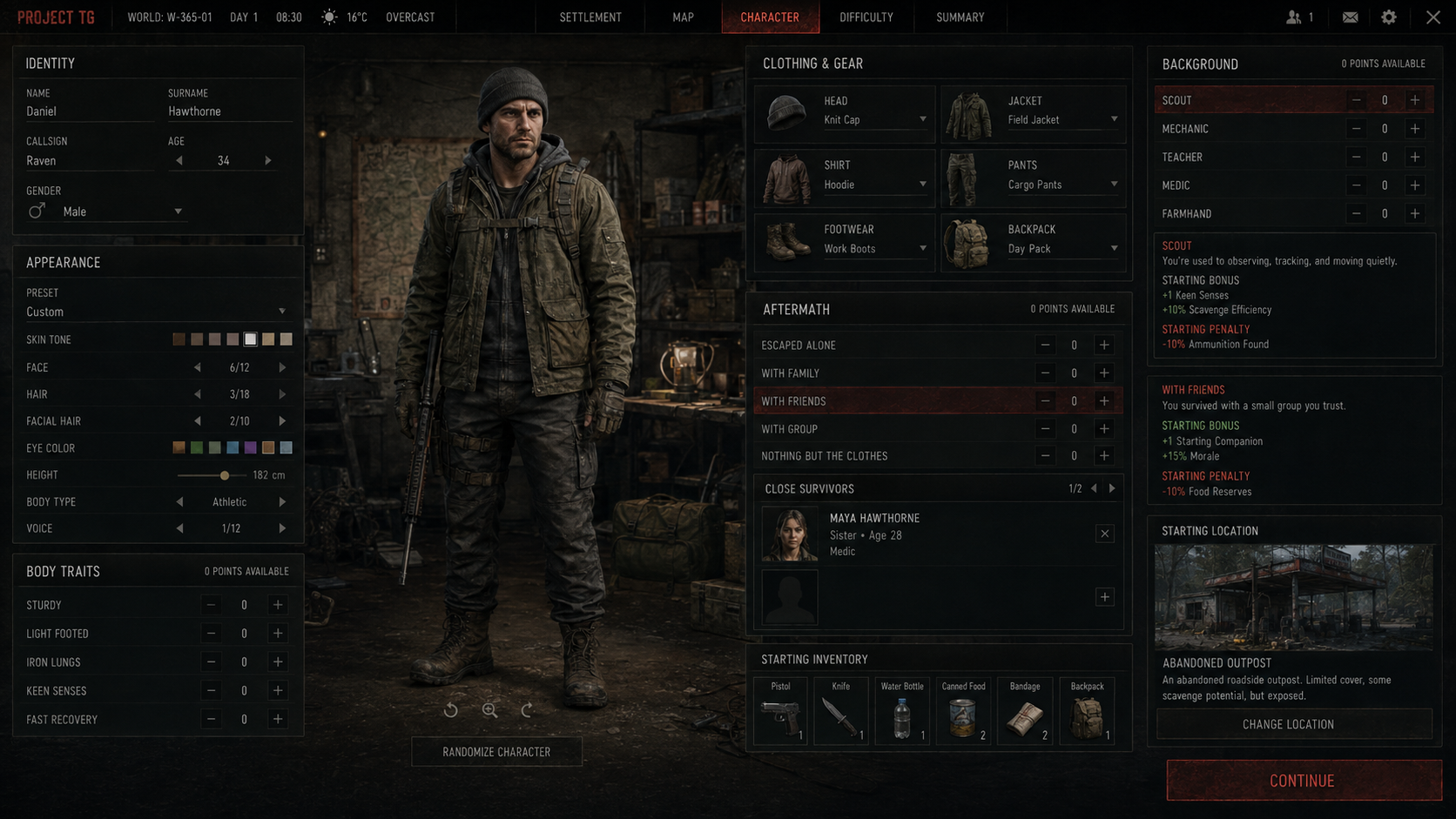
The pre-game character setup defines an individual person and a starting history. Appearance, age, gender, physical characteristics, background and aftermath establish the initial condition. These choices affect starting knowledge, relationships, location, possessions, injuries and social context. Leadership, religious roles, medicine, farming, trade, crime, scouting and independent travel can develop later through action, trust, capability and opportunity.
Survivor identity
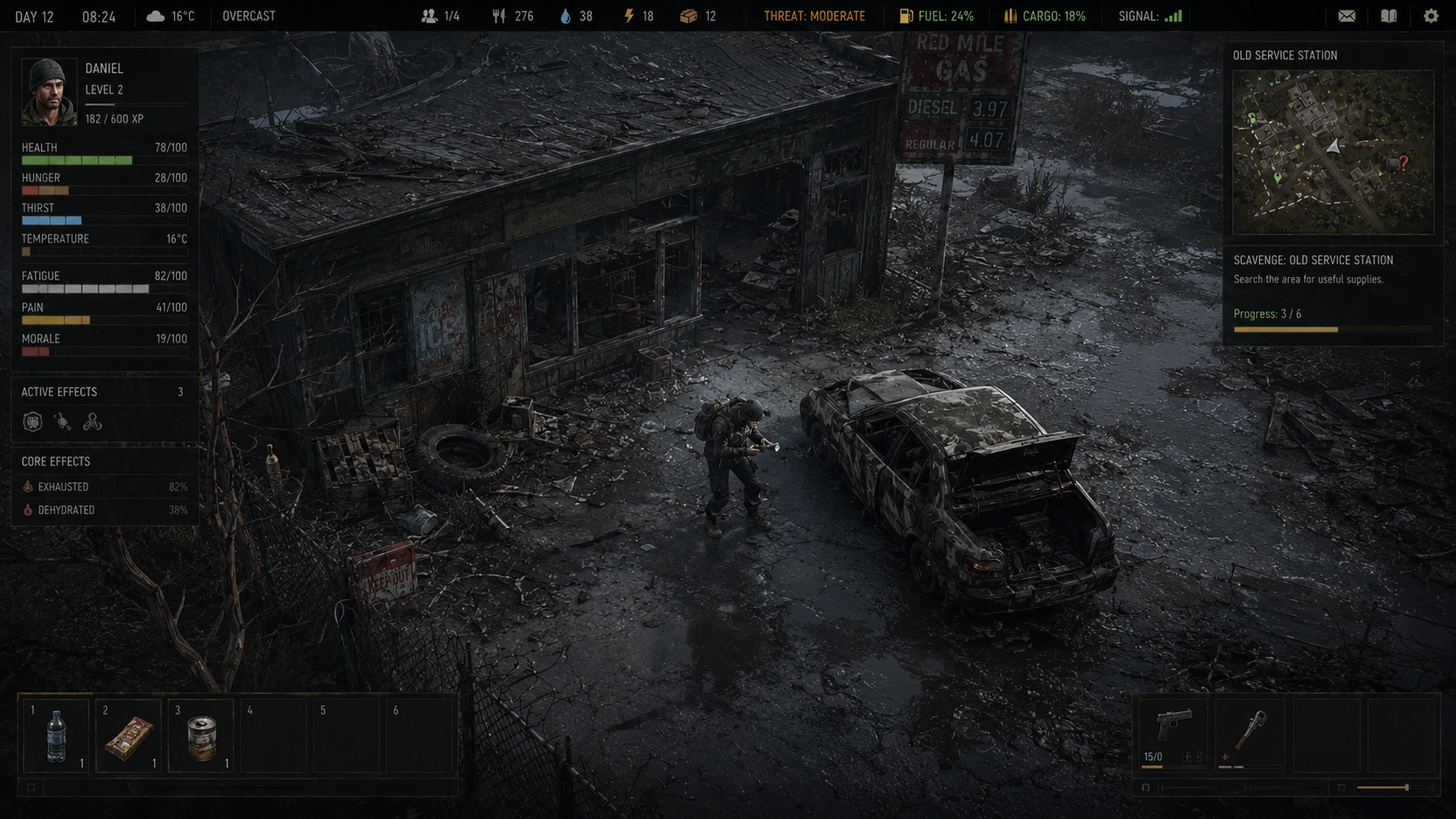
Name, appearance, age, gender and supported physical characteristics are configured before entry. Age and physical condition influence capability, recovery and risk.
Life before collapse
A small set of grounded histories establishes previous knowledge and experience. A medical worker, mechanic, farmer, student or other background begins with different familiarity and practical context.
Collapse aftermath
The aftermath establishes how the character reached the current world state. It can influence injury, trauma, starting equipment, location, known places and unresolved personal history.
Starting relationships
Pre-game decisions can leave the character alone or connected to surviving family, partners, friends or other close people. Those relationships create responsibility from the beginning.
Persistent health and aging
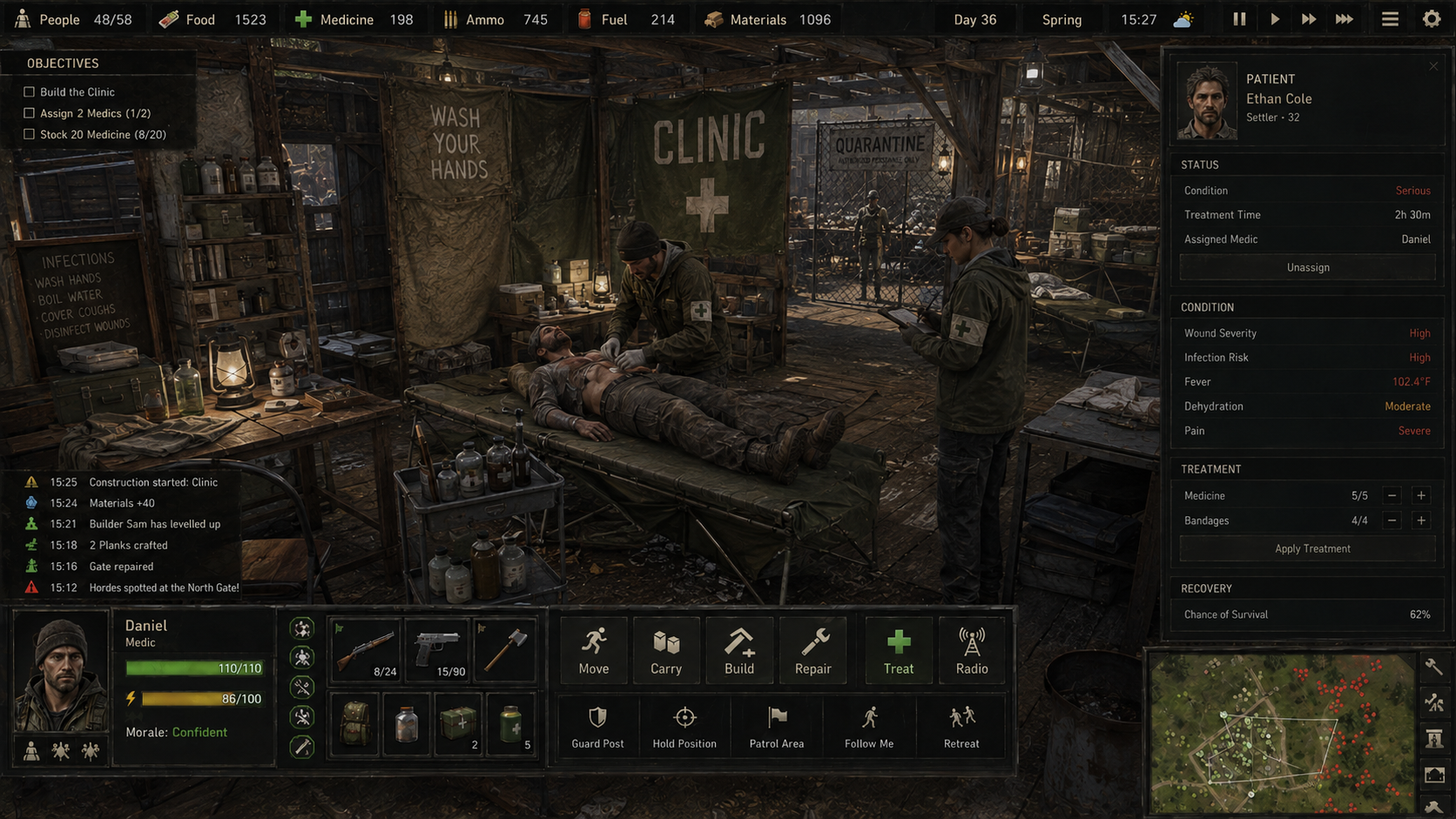
World time continues and character age advances with it. Health is treated as persistent state. Disease can begin through exposure or environment, progress through symptoms, respond to treatment, and affect work, movement, recovery and community risk.
- Injuries can leave lasting limitations or require extended recovery
- Age can change endurance, recovery, vulnerability and physical capability
- Sanitation, crowding, weather, nutrition and medical capacity can influence health pressure
- Medical knowledge and treatment quality affect outcomes through the same simulation state
Family and household continuity
Relationships accumulate shared history. When housing, food, safety and personal relationships support long-term life, people can form households and families. These ties influence migration, housing, risk tolerance, grief, priorities and leadership decisions.
- Partners and families remain individual people with their own needs and decisions
- Dependants increase practical responsibility during travel, shortage and conflict
- Loss can alter the behaviour and relationships of the people who remain
- Stable communities can develop a future that extends beyond immediate survival
Starting conditions
Starting conditions create immediate survival obligations
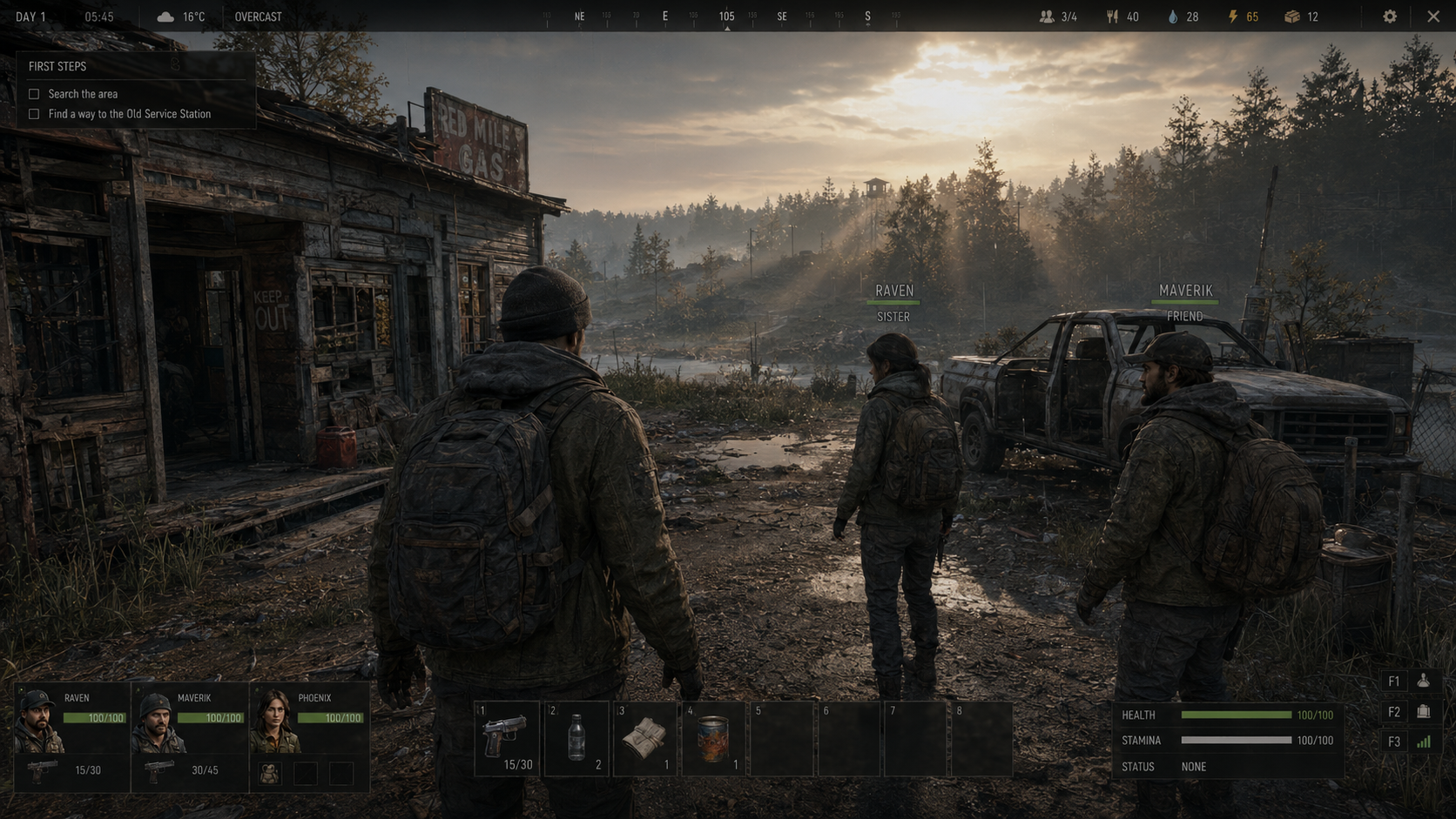
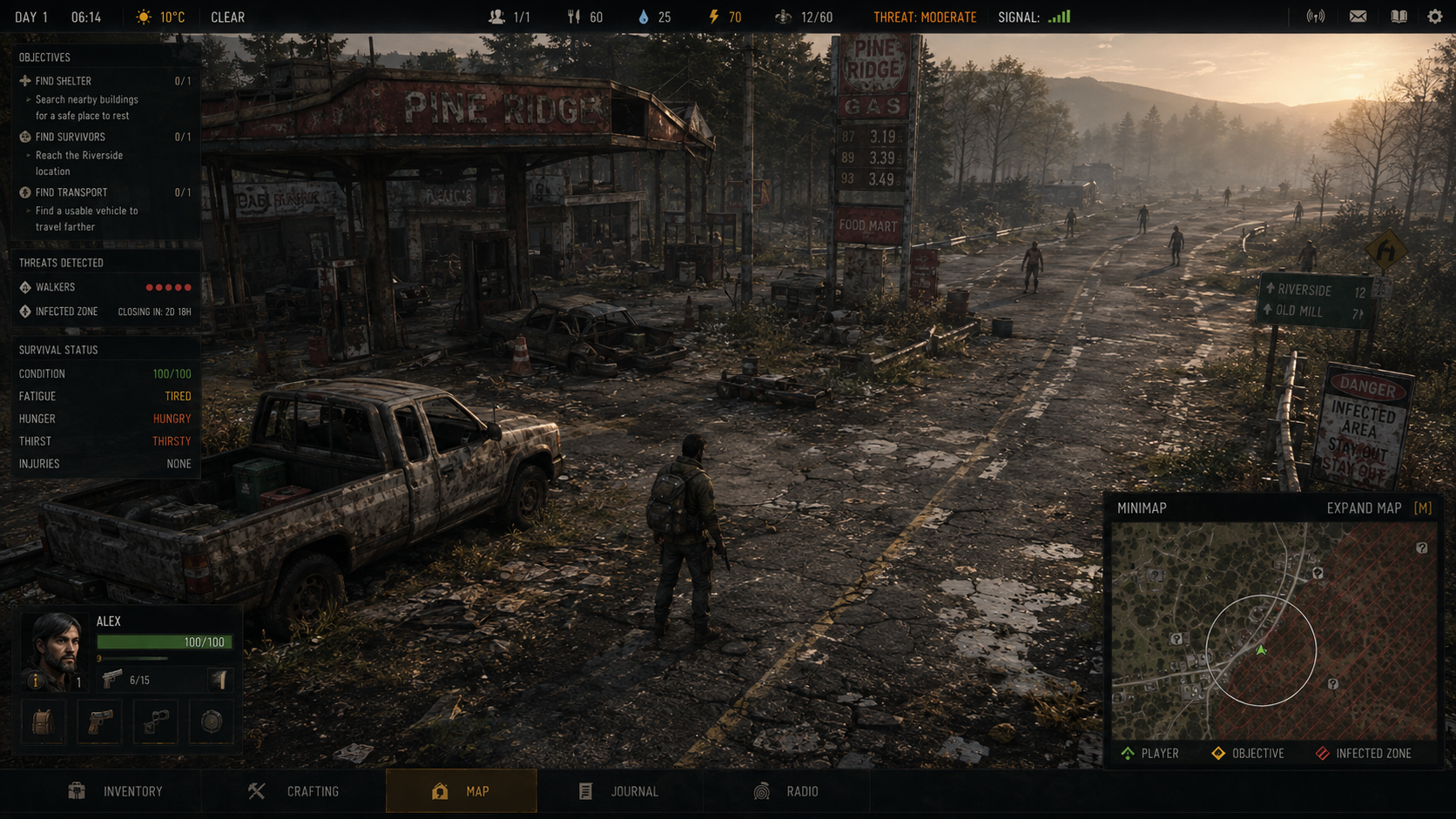
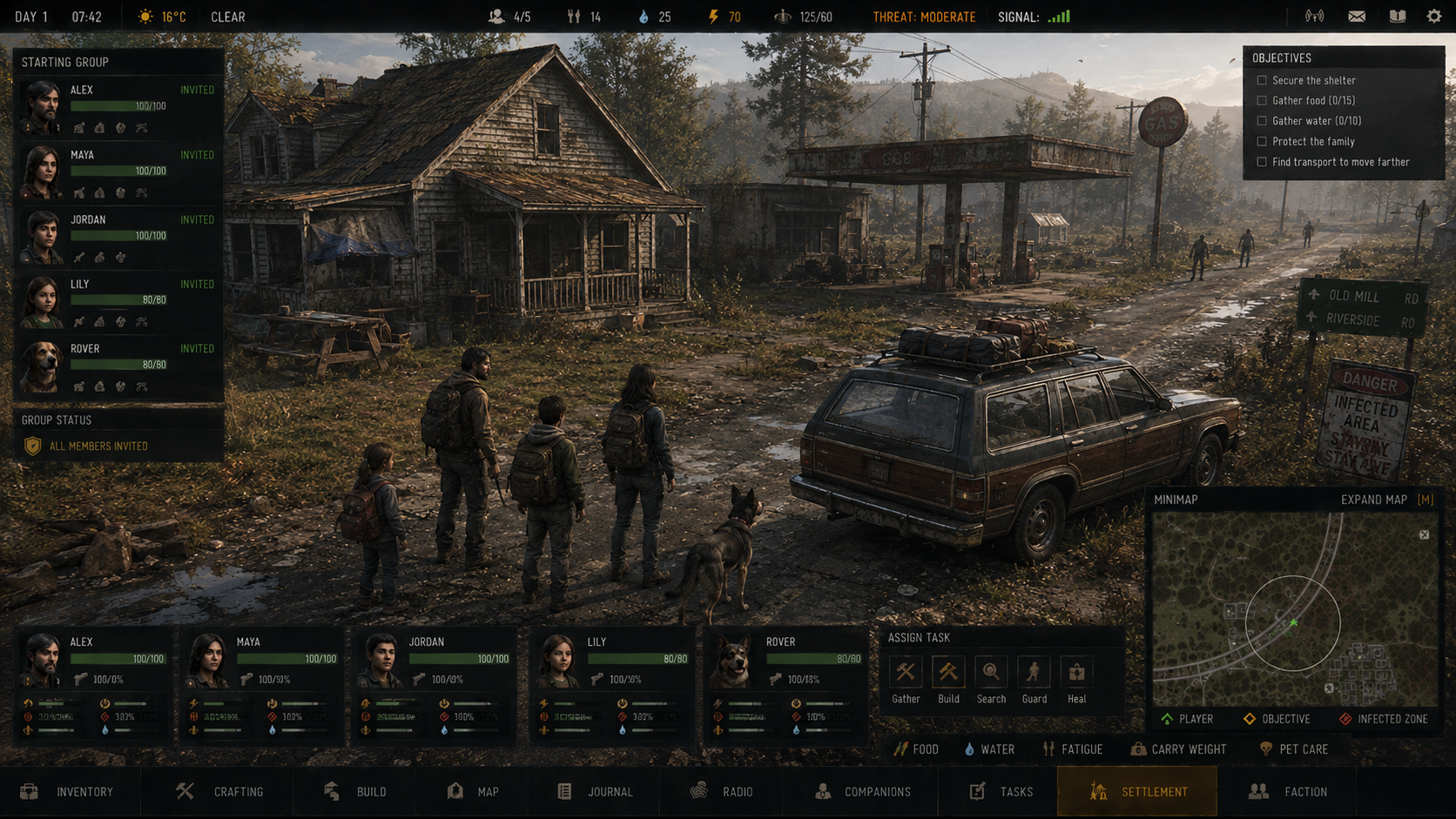
The simulation begins as soon as the selected aftermath is loaded. A solo start creates one human-controlled survivor. A family start uses the surviving relatives and close relationships selected before entry. A pet can be included when the chosen start supports one. Shelter, hunger, thirst, fatigue, infected pressure, transport access and local danger are active from the first playable state.
Manual player control
A character currently controlled by a real player does not travel, search, fight, sleep, change equipment, accept work or make deliberate survival decisions without that player's input. AI-controlled characters remain separate persistent people until control is transferred through an authorised system.
- Travel routes are initiated and managed by the controlling player
- Rest, watch duty, equipment and task allocation require explicit decisions
- Family and community resources are not automatically optimised
Pet and livestock care
Pets and livestock consume food, water, shelter capacity, medicine and care labour. Their health and survival persist with the world. Failure to provide adequate care can cause weakness, disease, loss of capability and permanent death.
- Animals create daily consumption before they provide work or production value
- Care, feeding, medical attention and shelter require assigned resources
- Keeping large animal populations alive increases land, labour and storage pressure

Real-Earth map
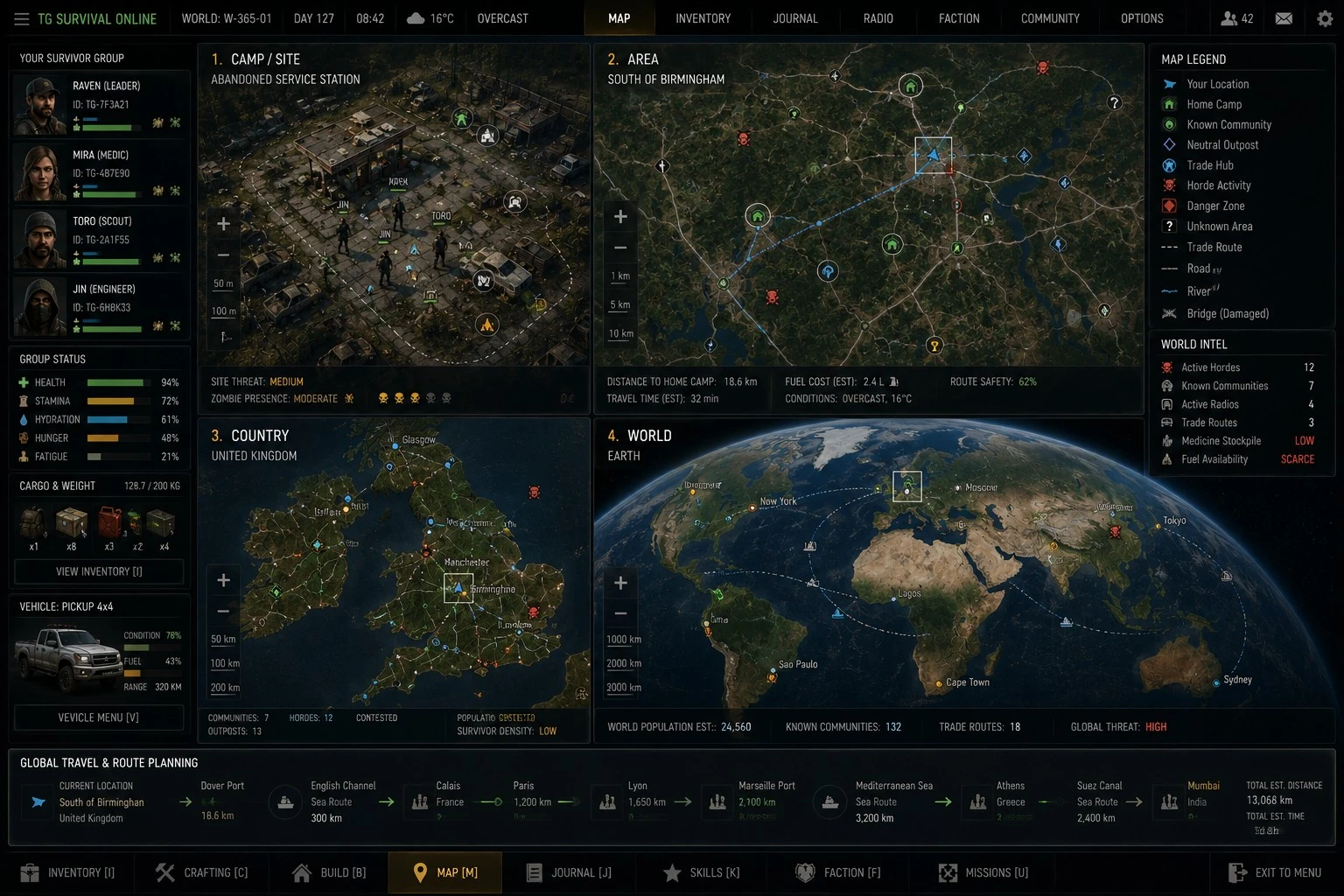
Every map scale uses the same geographic coordinates
TG uses real geographic position as the world foundation. Real city names, supported place names, coastlines, major routes, rivers, terrain and administrative geography establish location. Tactical buildings, interiors, objects and post-collapse damage are generated as game content for the local site.
- The minimap remains available during normal play and can expand into site, area, country and world views.
- Generated local detail uses geography, land use, climate, access difficulty, survival pressure and existing world state as inputs.
- A difficult or isolated location can produce different shelter, access, resource and transport conditions without changing the real geographic position.
- The server can hold exact world state while the player sees only map knowledge and intelligence that their character or community has obtained.
- Distant regions retain persistent state through lower simulation detail until players, NPCs or events require local activation.
Travel
Travel consumes people, transport, supplies and route capacity
Travel can be initiated for scavenging, hunting, trade, rescue, diplomacy, family search, prisoner movement, evacuation, relocation, migration or settlement founding. The route state is calculated from the selected people, transport, cargo, provisions, fuel, weather, terrain, vehicle or vessel condition and current map knowledge.
- Route stateDistance, expected duration, known hazards, route condition and destination knowledge update as the expedition moves.
- People and capacityPassengers, crew, pack weight, cargo volume, food, water and medical capacity limit what a group can carry and how long it can remain away.
- Transport stateVehicles and vessels keep condition, load, fuel or propulsion state. Damage or overload can reduce speed, range and safe capacity.
- World continuityLong routes advance through geographic segments. Encounters, weather, breakdowns, navigation errors and contact with other groups can activate detailed local play.


Exploration
Each location defines access, resources, visibility and route risk
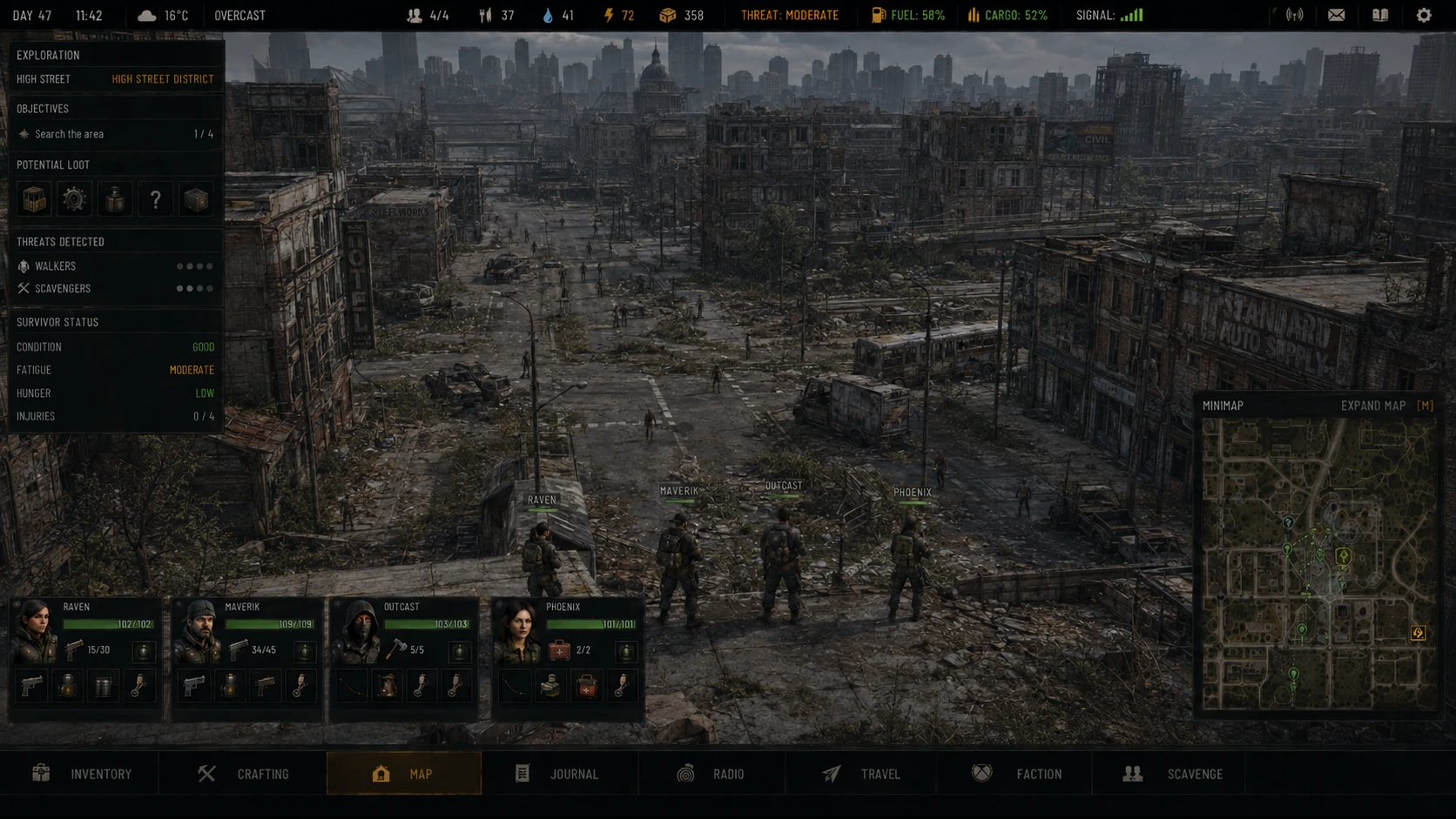
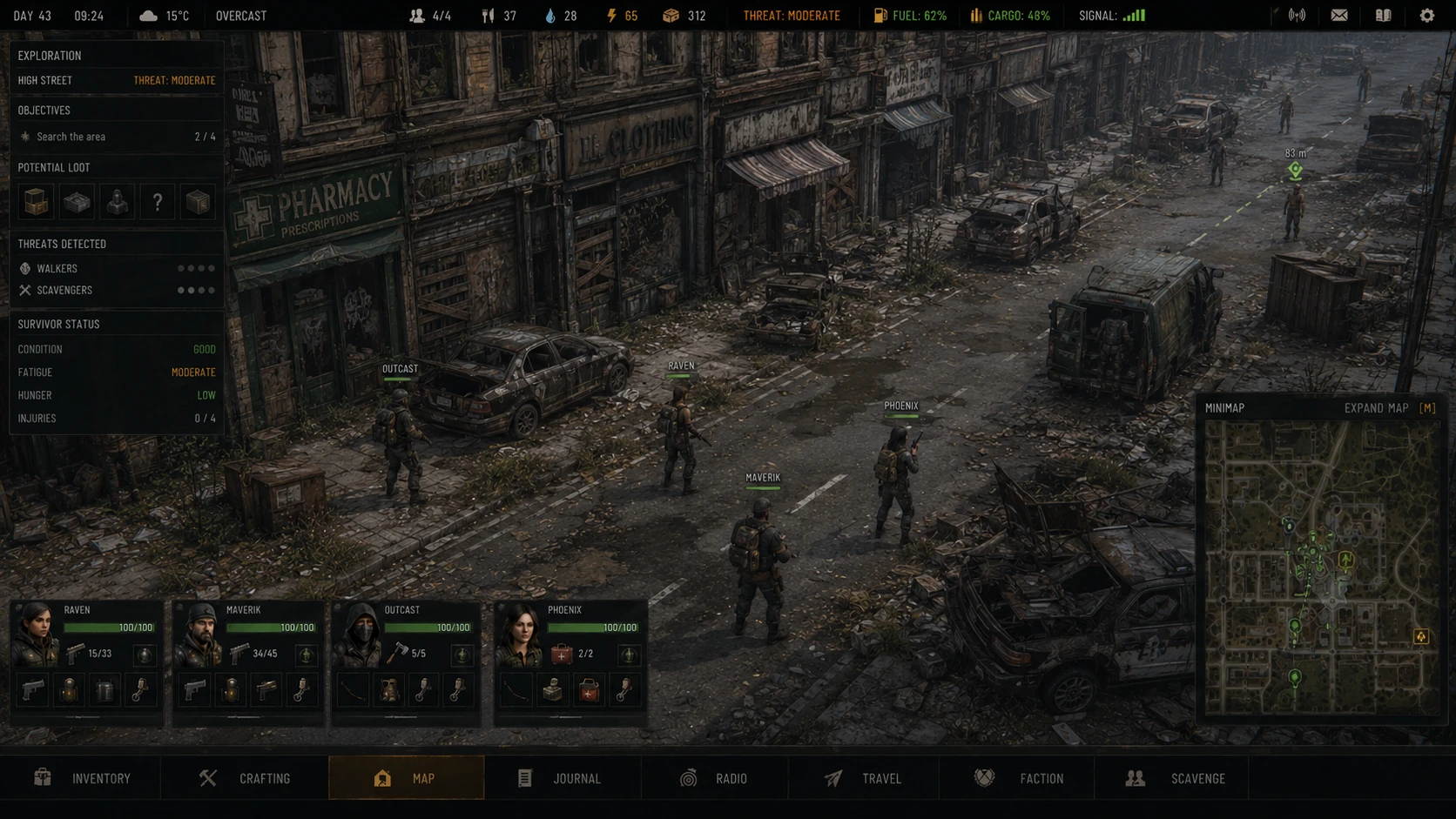
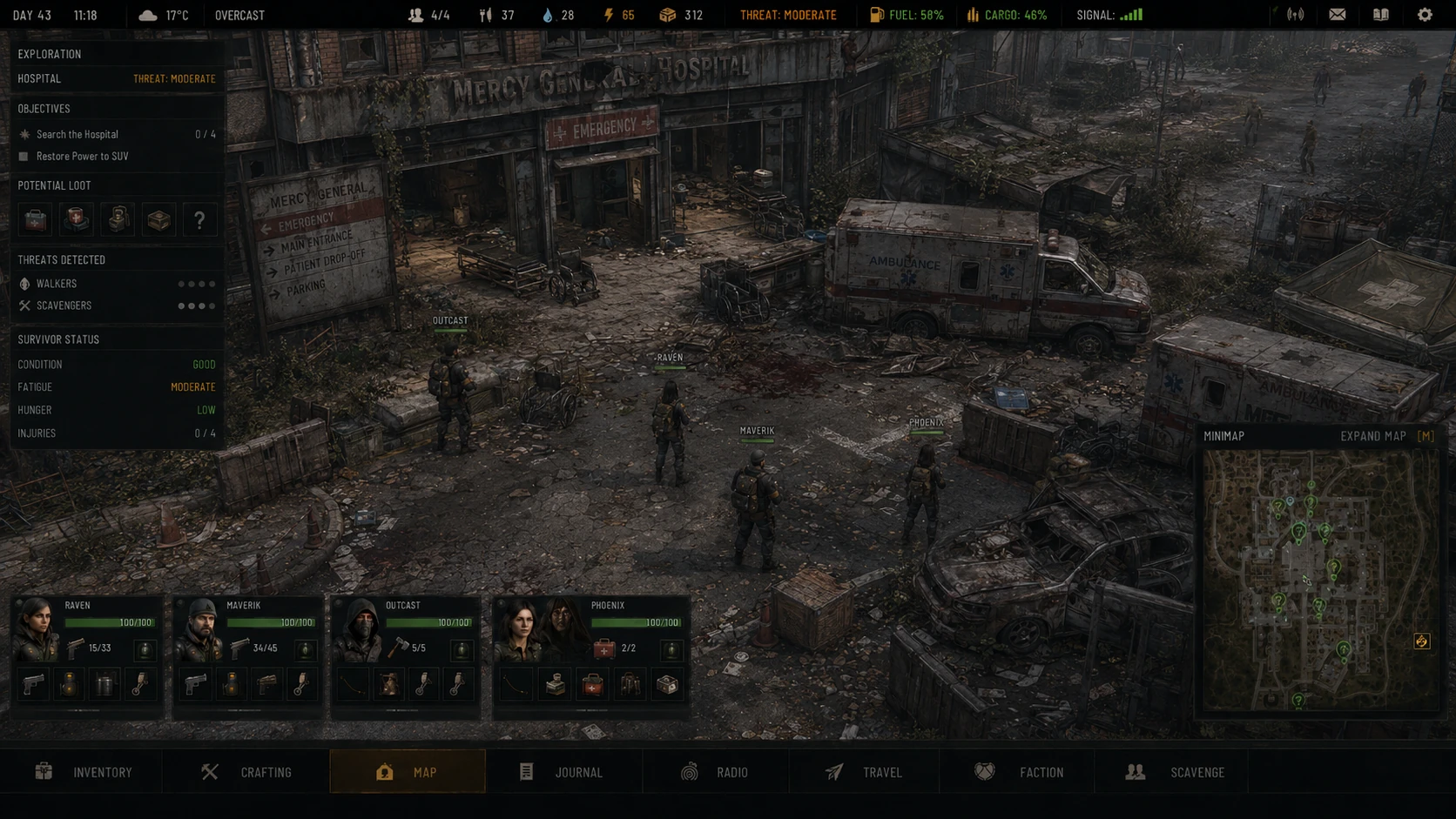
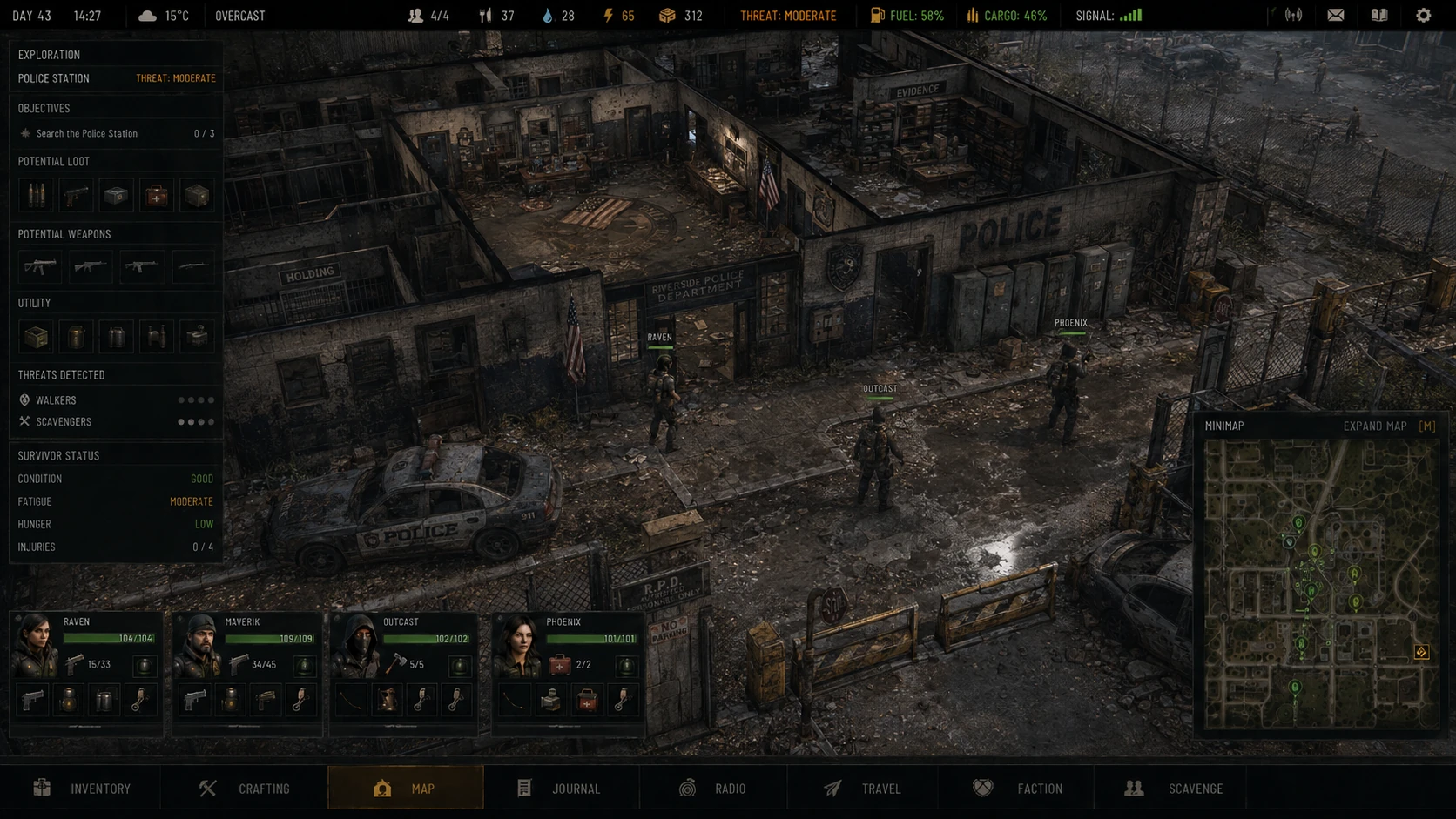
The Earth layer supplies geographic position, city and district identity, major roads, rivers, bridges and terrain. When a local site activates, TG generates the tactical layout, interiors, vehicles, debris, access points and post-collapse condition from the site archetype and persistent world state. Search results then depend on the site's original function, previous depletion, damage, occupation and current access.
- High streetsShops, pharmacies, service access, parked and abandoned vehicles, rear entrances and street obstructions create several search paths within one block.
- HospitalsMedical stores, treatment areas, ambulances, utility rooms and quarantine-capable spaces can provide high-value medical recovery. Previous evacuation and looting reduce what remains.
- Police stationsEvidence rooms, holding areas, protective equipment, communications, utility stores and secured weapon storage can exist when the generated site state supports them.
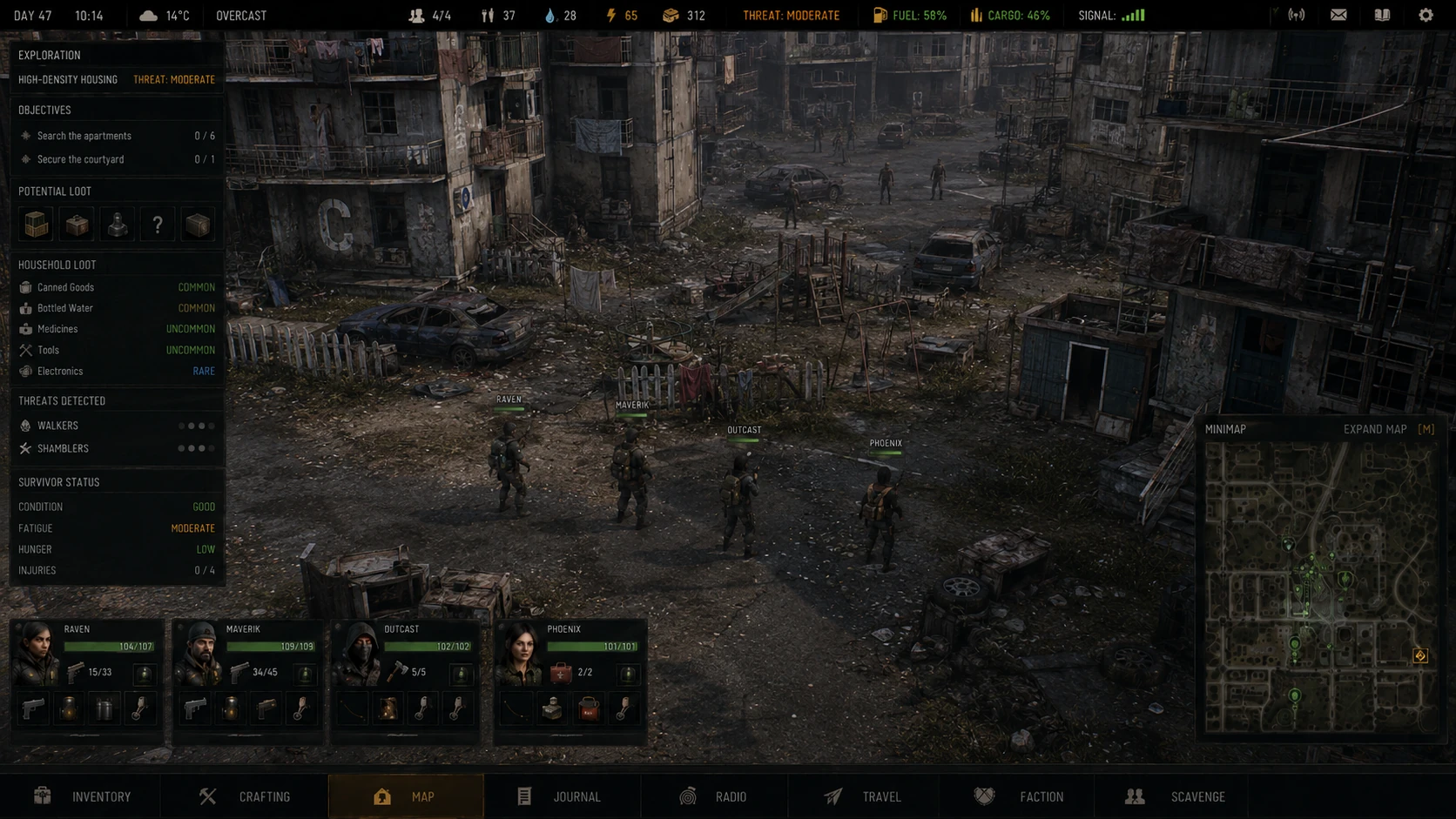
- Housing blocksApartments, shared courtyards, household stores, narrow access routes and multiple vertical sight lines create dense local search spaces.
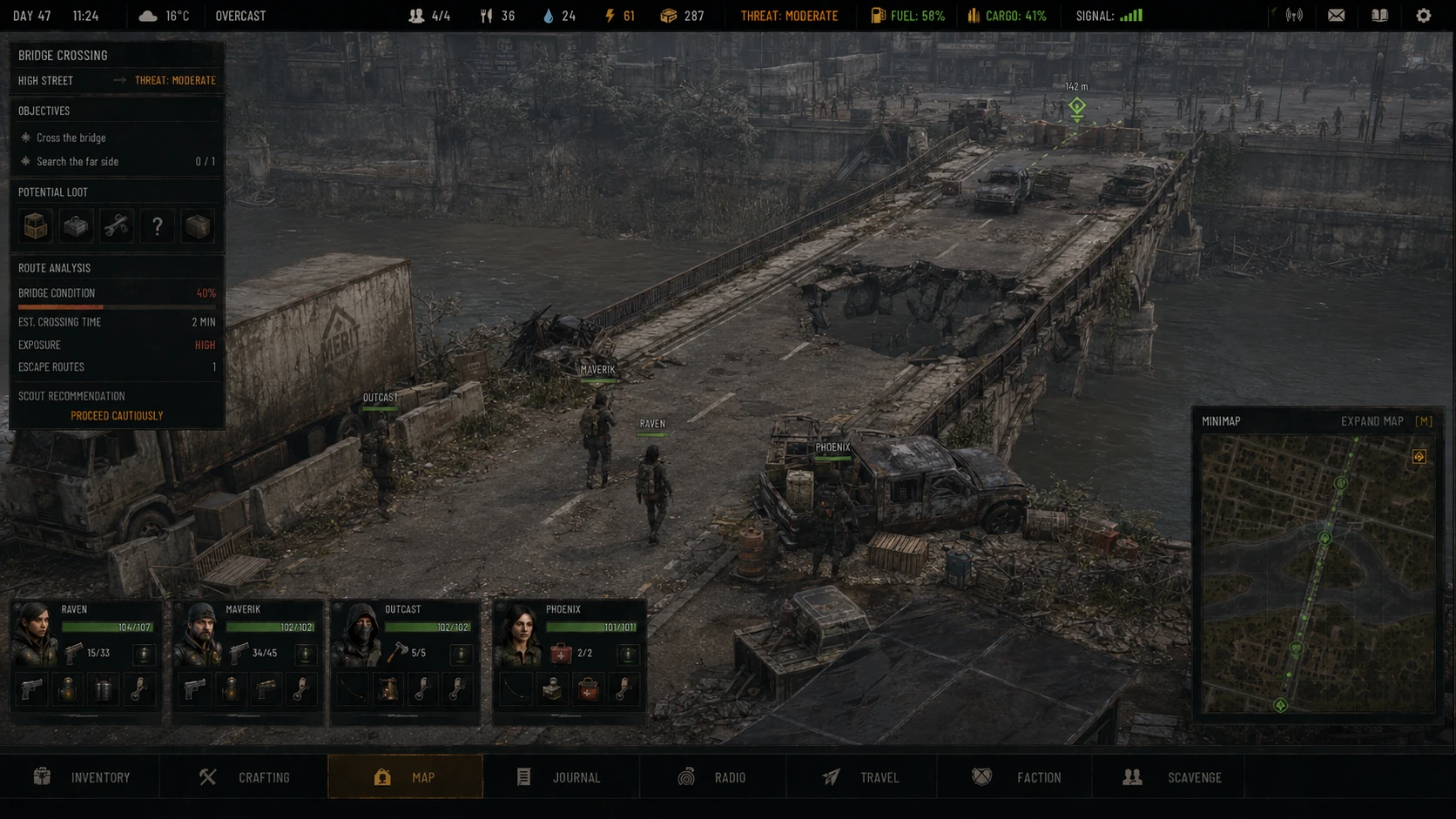
- BridgesBridge condition, blockage, structural damage, exposure and remaining crossing width determine whether the route is usable and what alternate route is required.
- Infected distributionSlow infected occupy streets and sites according to local population history, barriers, activity, migration, noise and elapsed time. Distant infected can remain visible before they become an immediate engagement.
Physical interaction
Physical properties determine what players can take, move and repurpose
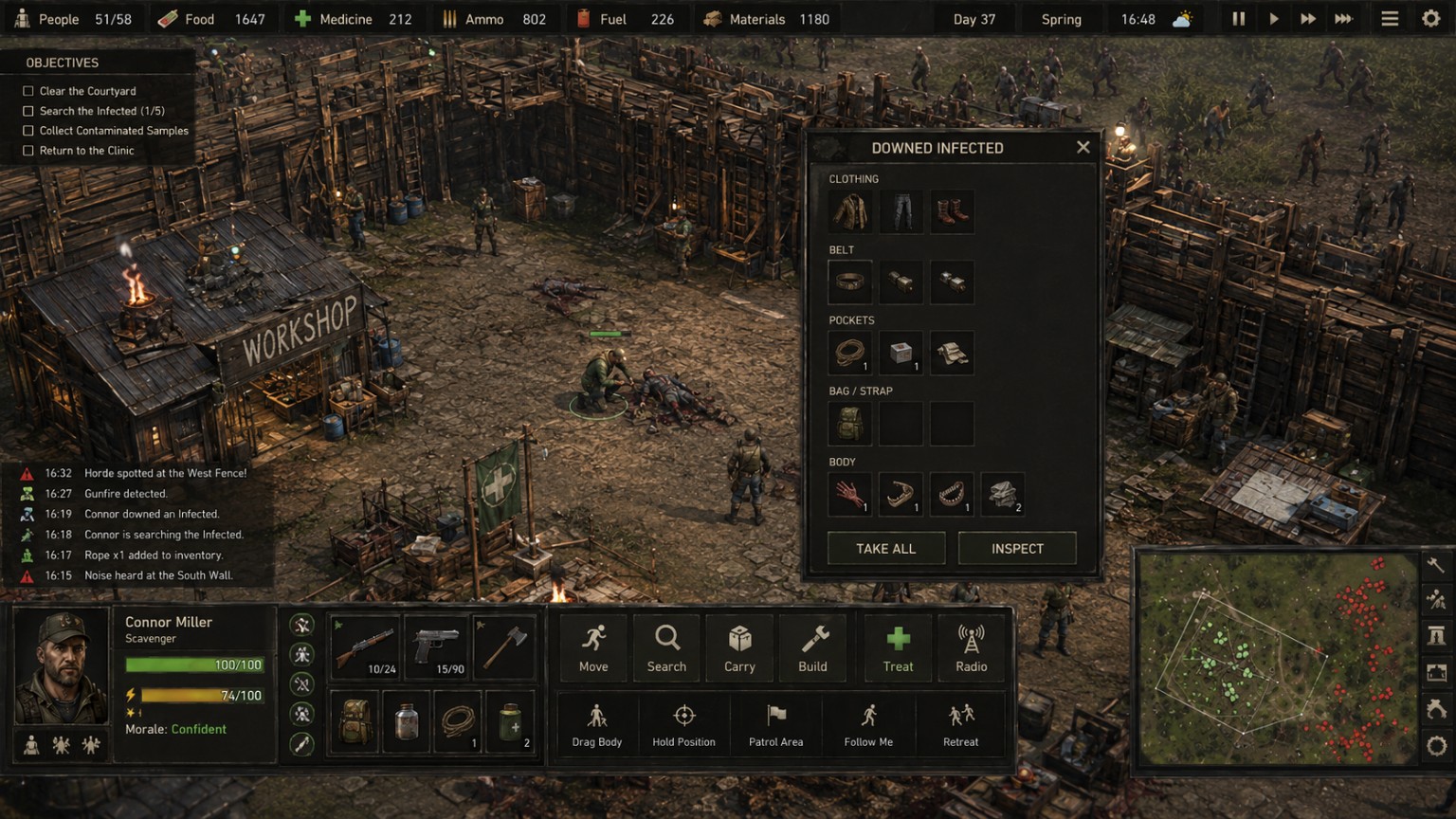
Homes, vehicles, workshops, farms, bodies and infrastructure contain useful things. Gathering uses direct interaction with physical objects. If an object physically exists and can plausibly be taken, moved, dismantled, connected, repaired or repurposed, the interaction system should recognise that capability.
- A battery remains an electrical source. Wire conducts. Water changes electrical and fire behaviour. Rope can connect or restrain.
- Fire produces heat, light and smoke. Rain changes wetness, ignition and electrical risk through shared world rules.
- Objects are defined by reusable properties, materials, states and connection points so unexpected player combinations can work without a bespoke recipe.
- Scarcity comes from condition, relevance, access, transport, depletion and the danger involved in recovery.
Settlement development
Settlement growth increases capability and responsibility
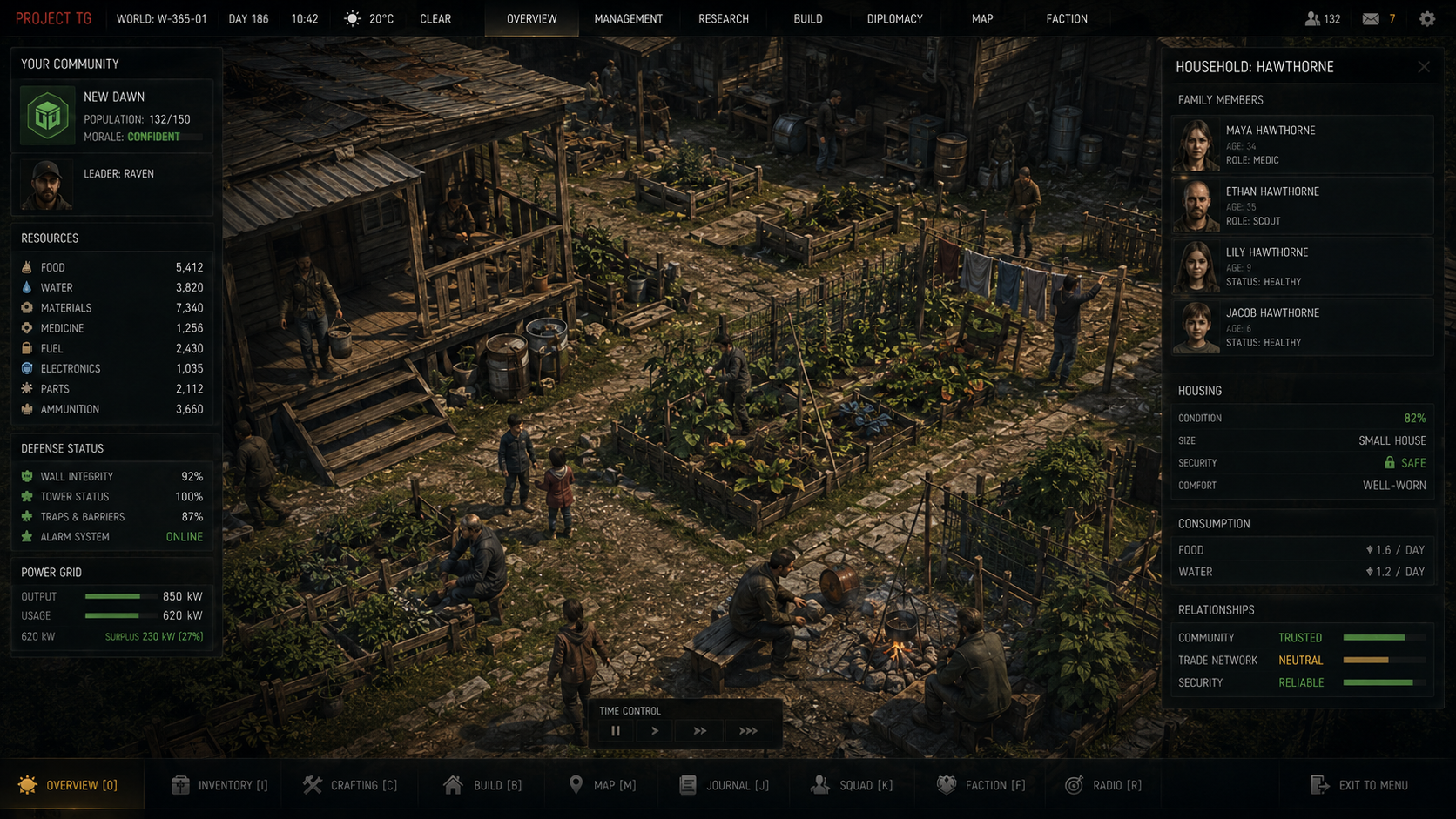
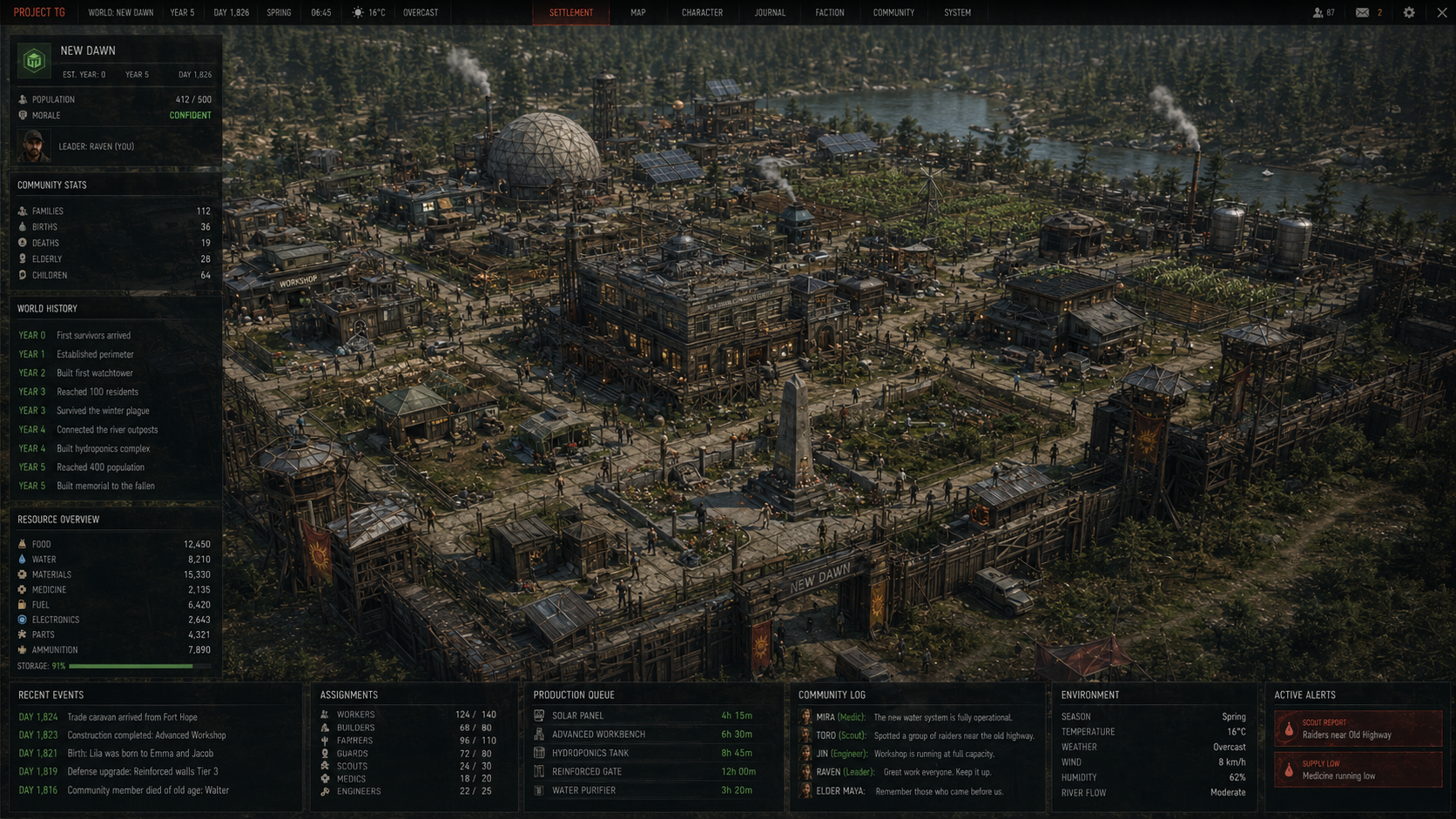
Construction stays strategically important without becoming a building simulator. Players choose what and where to build. Survivors supply labour and materials. Farming, medicine, workshops, water, power, transport, animals, religion, law, recreation, relationships and family life become possible as capability and safety improve.

Survivor
Immediate survival
Shelter, water, food, useful objects, movement, health, concealment and the decision to stay or travel.
Community
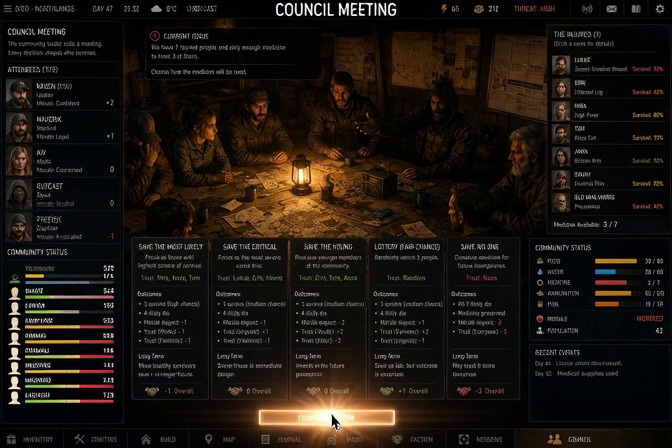
Community life
Trust, grief, responsibility, theft, leadership, disagreement, work and difficult decisions determine whether people stay together.
Settlement
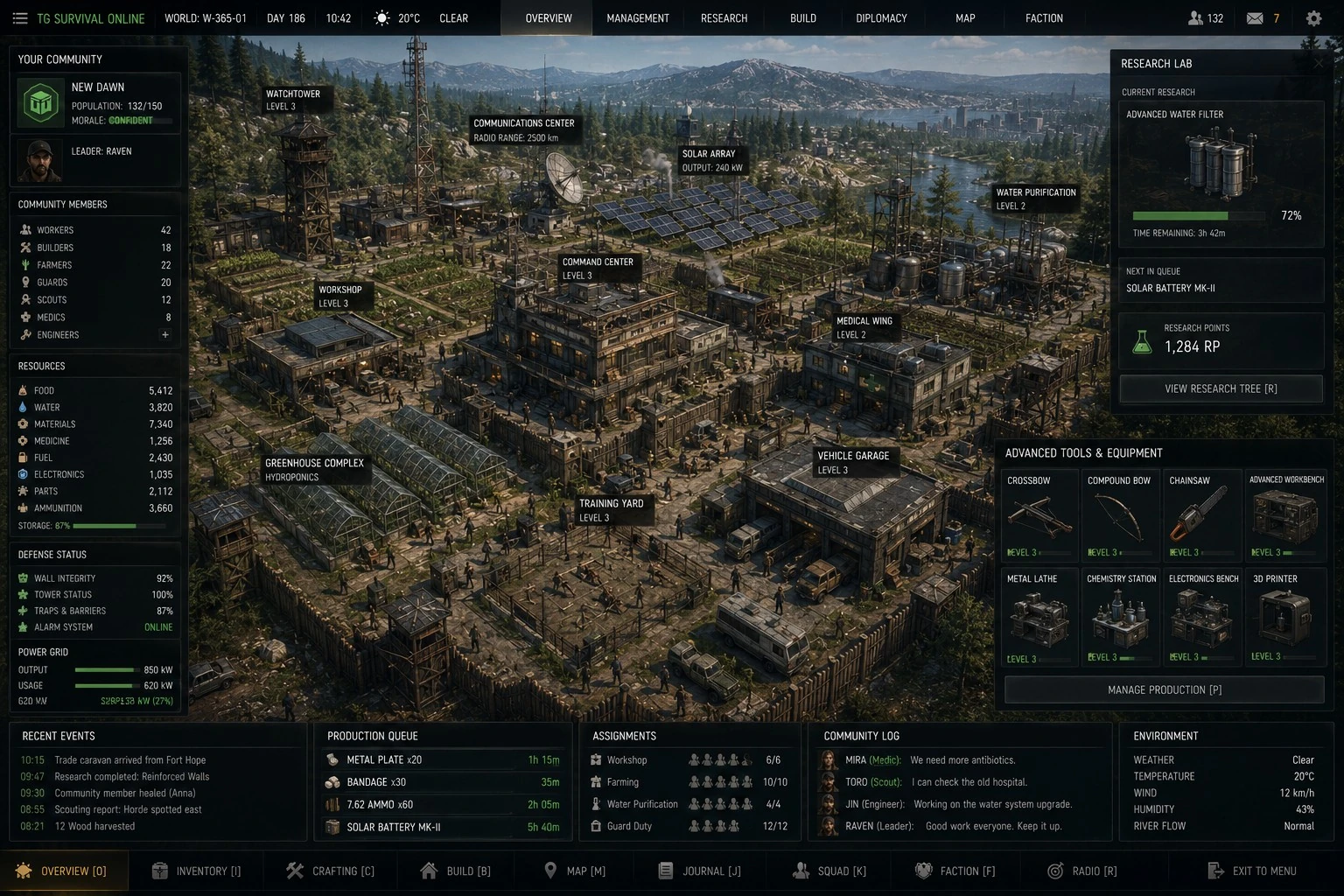
Settlement capability
Food production, clinics, workshops, watch systems, communications, transport, research and institutions increase opportunity while creating larger needs and larger targets.
Community scale and authority
Community size depends on available resources and management capacity
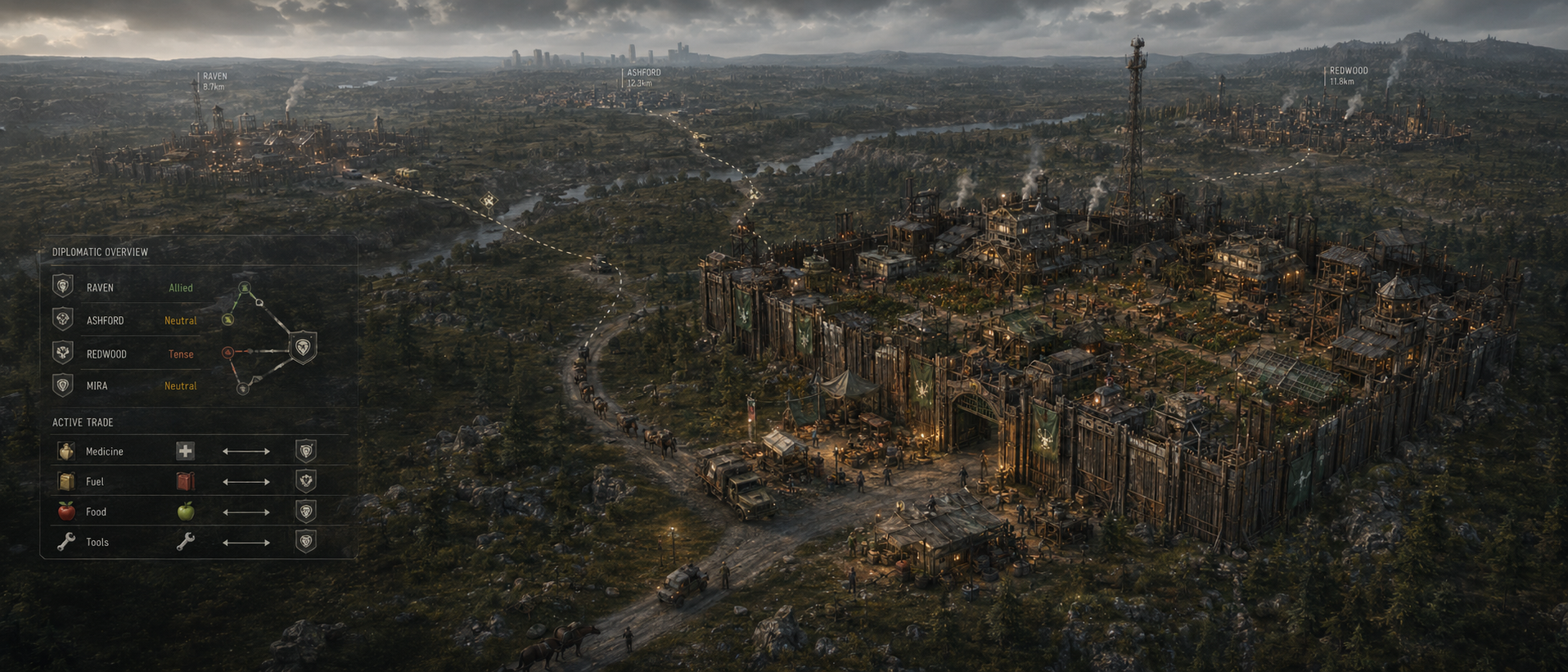
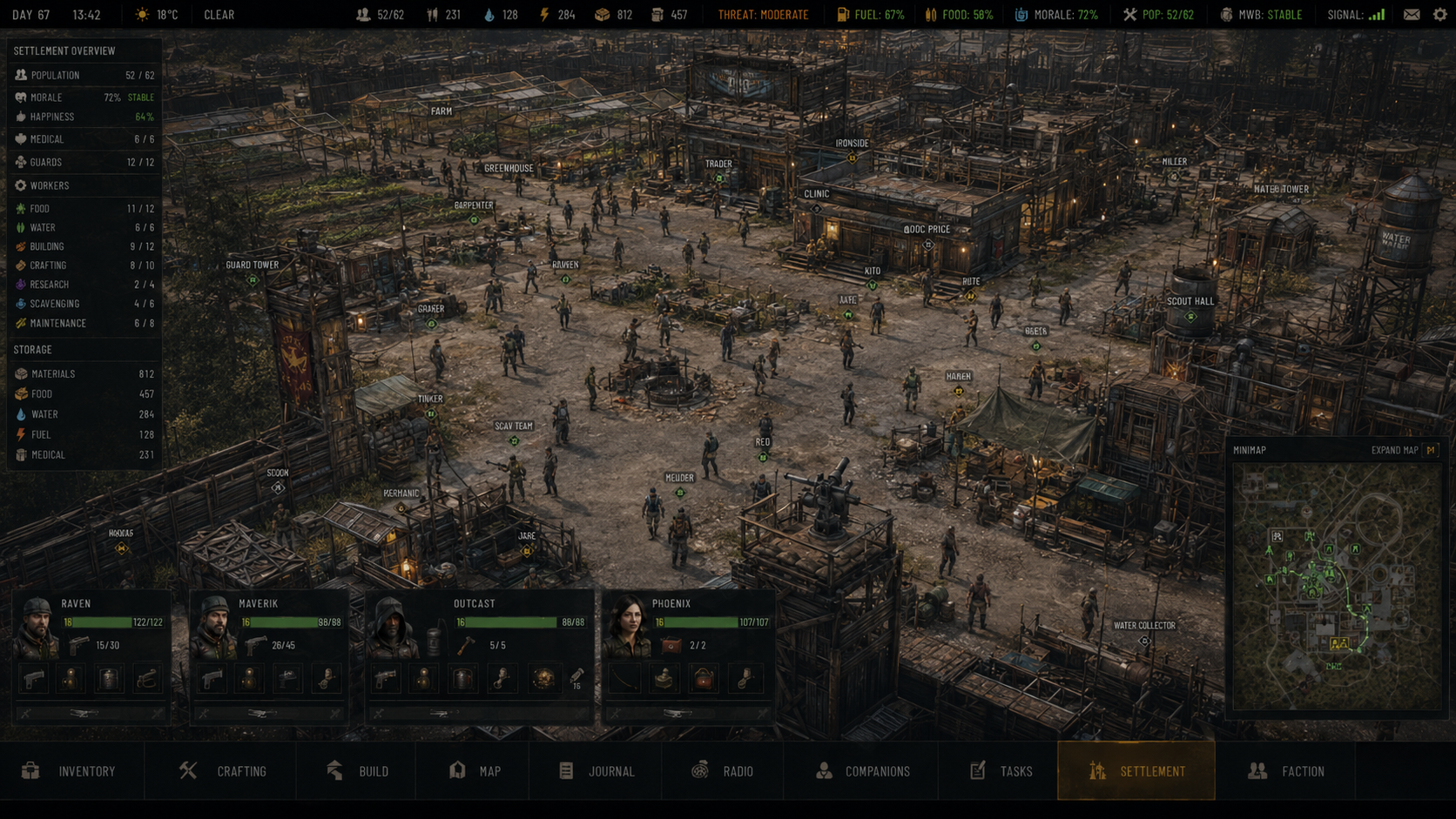
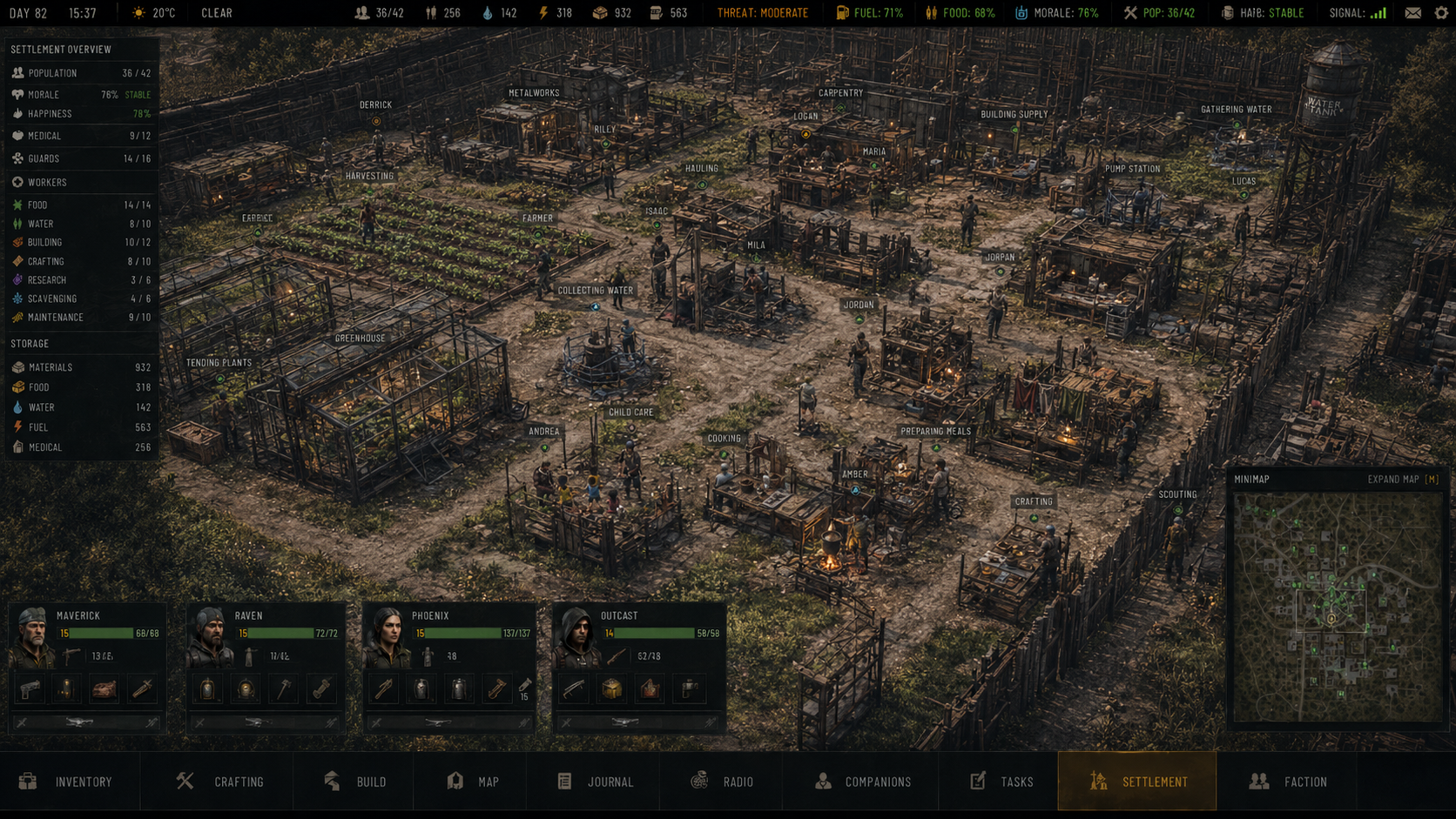
A population remains viable through food, water, housing, sanitation, medicine, labour, security, transport and governance capacity. Each resident keeps a persistent character identity. Settlement panels aggregate work and resource state while selected, tasked and tactically relevant people remain individually addressable.
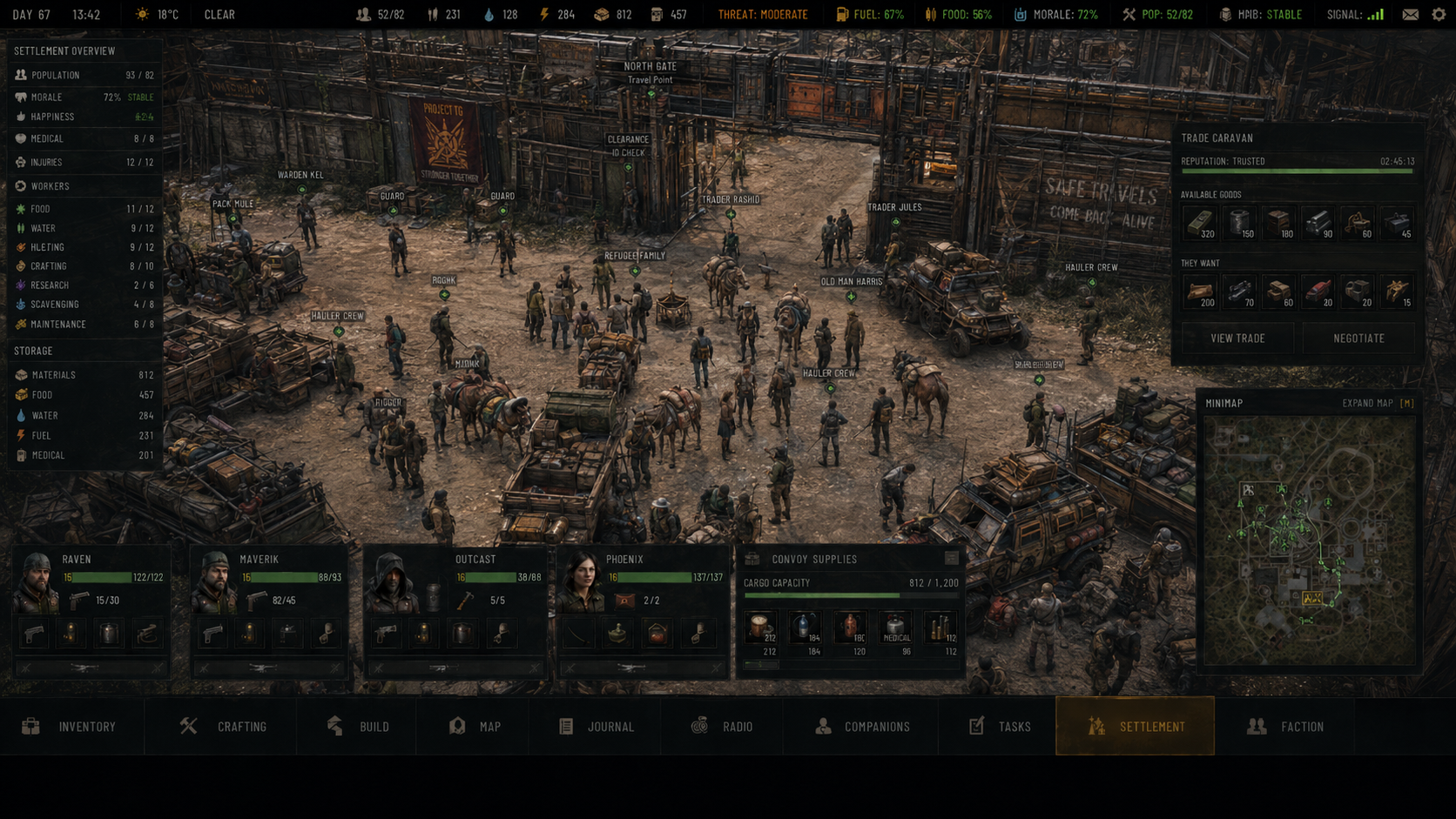
- Operational capacityPopulation pressure increases consumption, housing demand, disease exposure, work coordination, gate traffic and defensive staffing.
- Work assignmentFarming, hauling, cooking, child care, water collection, crafting, construction, scouting and maintenance compete for available people.
- Trade accessVisiting caravans can be checked at gates, recognised through reputation, admitted under local rules and negotiated against available cargo.
- Alert reassignmentThreats can move people from normal work into gate crews, towers, ammunition handling, medical support, evacuation or reserve positions.
- Interface densityName and role markers focus on selected, assigned or tactically relevant people. Population-wide status remains available through the settlement panel.
- Server capacitySimulation LOD and region partitioning reduce detail for distant people and inactive areas while preserving persistent identity and consequential state.
Community leadership
Inside an established community, leadership support uses recorded community work, responsibilities, trust, results, social standing and the governance rules adopted by that community. Work performed for the community is a primary source of legitimacy.
- Leadership authority is stored as a community relationship and permission state
- Support can change after failure, absence, death, conflict or loss of trust
- Community rules can define how authority is granted, challenged or transferred
Independent leadership
Outside an established community, leadership can form from personal resources, field experience, demonstrated competence, equipment or transport control, reputation, followers and coercive power.
- A well-supplied survivor can attract people who depend on those resources
- Experience and successful decisions can increase voluntary support
- Control of weapons, transport or supplies can create coercive authority
Granted authority can include helping or admitting people, abandoning a person or group, assigning punishment, detention or exile, and seizing property, cargo, vehicles or controlled space. The action is recorded through witnesses, evidence, ownership changes, relationship memory and community history.
Admission, quarantine and expulsion
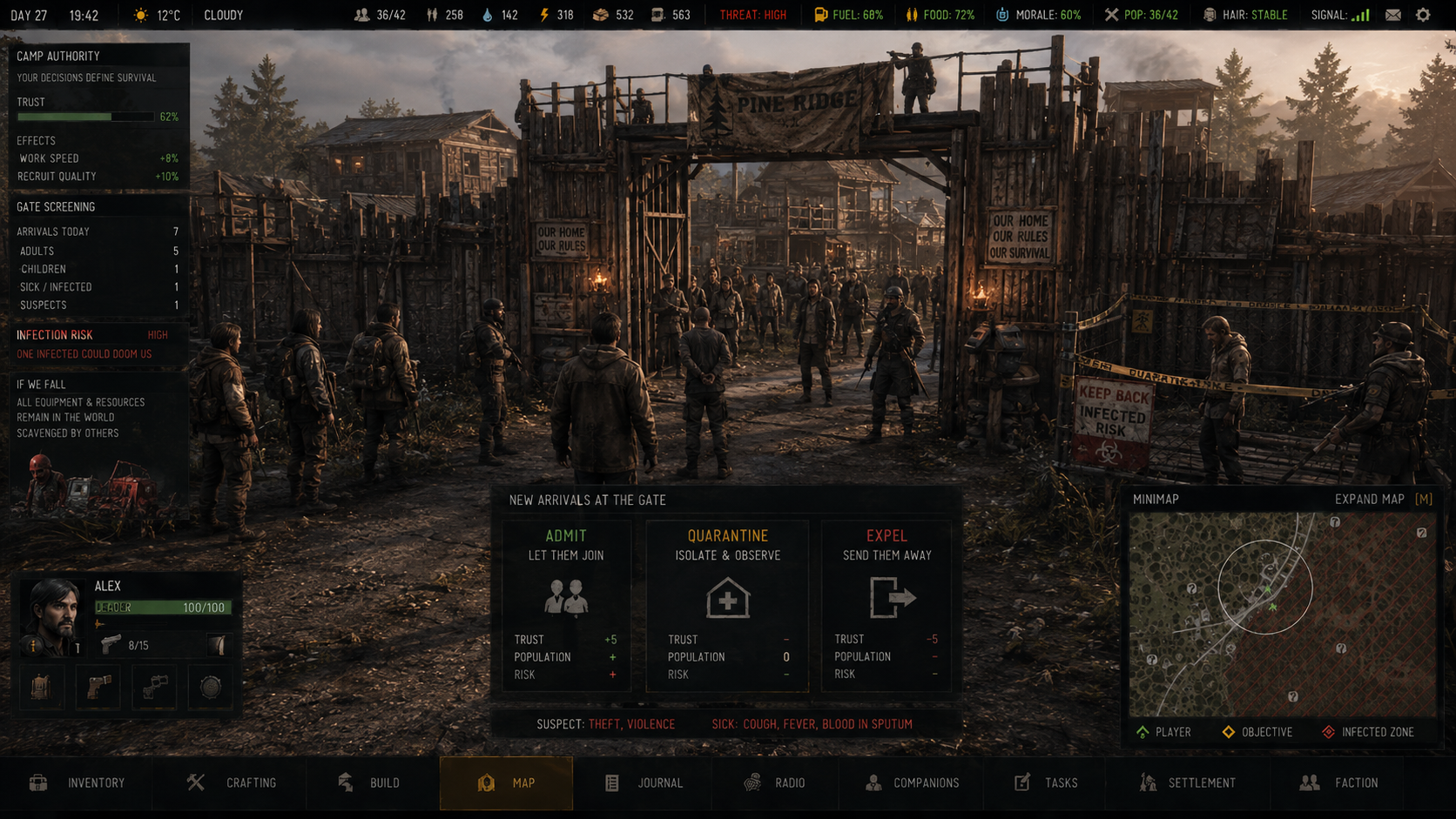
When local governance gives a leader gate authority, that leader can admit, quarantine, refuse or expel arrivals. Decisions use visible symptoms, medical examination, witness reports, known exposure and other information available inside the simulation. Hidden infection is not revealed automatically.
- An admitted infected survivor can create an internal outbreak through ordinary contact and disease rules
- Criminal expulsion depends on local rules, evidence, witnesses and authority
- A collapsed settlement remains physically present with surviving structures, vehicles, equipment and stored resources available to later scavengers or occupiers
- Starting an unrelated new character does not restore the collapsed settlement or return consumed resources
Community rituals and institutions
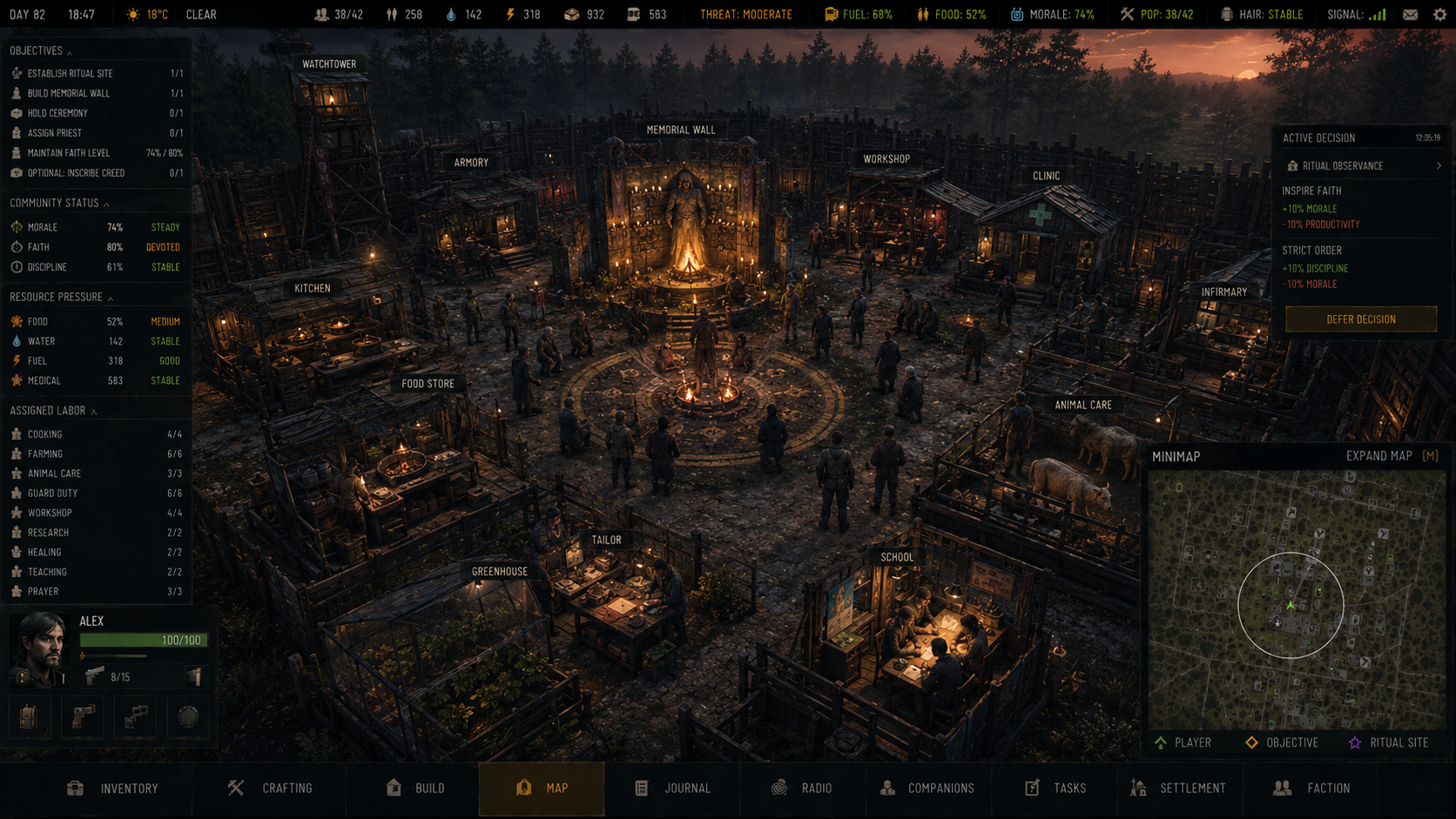
Communities can create religious practices, memorials, ceremonies, oaths and repeated customs through generic social systems. A practice can define participants, location, time, objects, symbols, leadership, repetition, rules and resource cost without requiring a pre-named ritual template.
- Gatherings consume time and can reduce available labour or security coverage
- Food, fuel, objects and designated spaces can become part of repeated practice
- Participant memory, grief, trust, belonging, discipline and conflict can change through the resulting events
- The world history system records consequential customs and institutions created by players

Human consequences
Leadership decisions create persistent human consequences
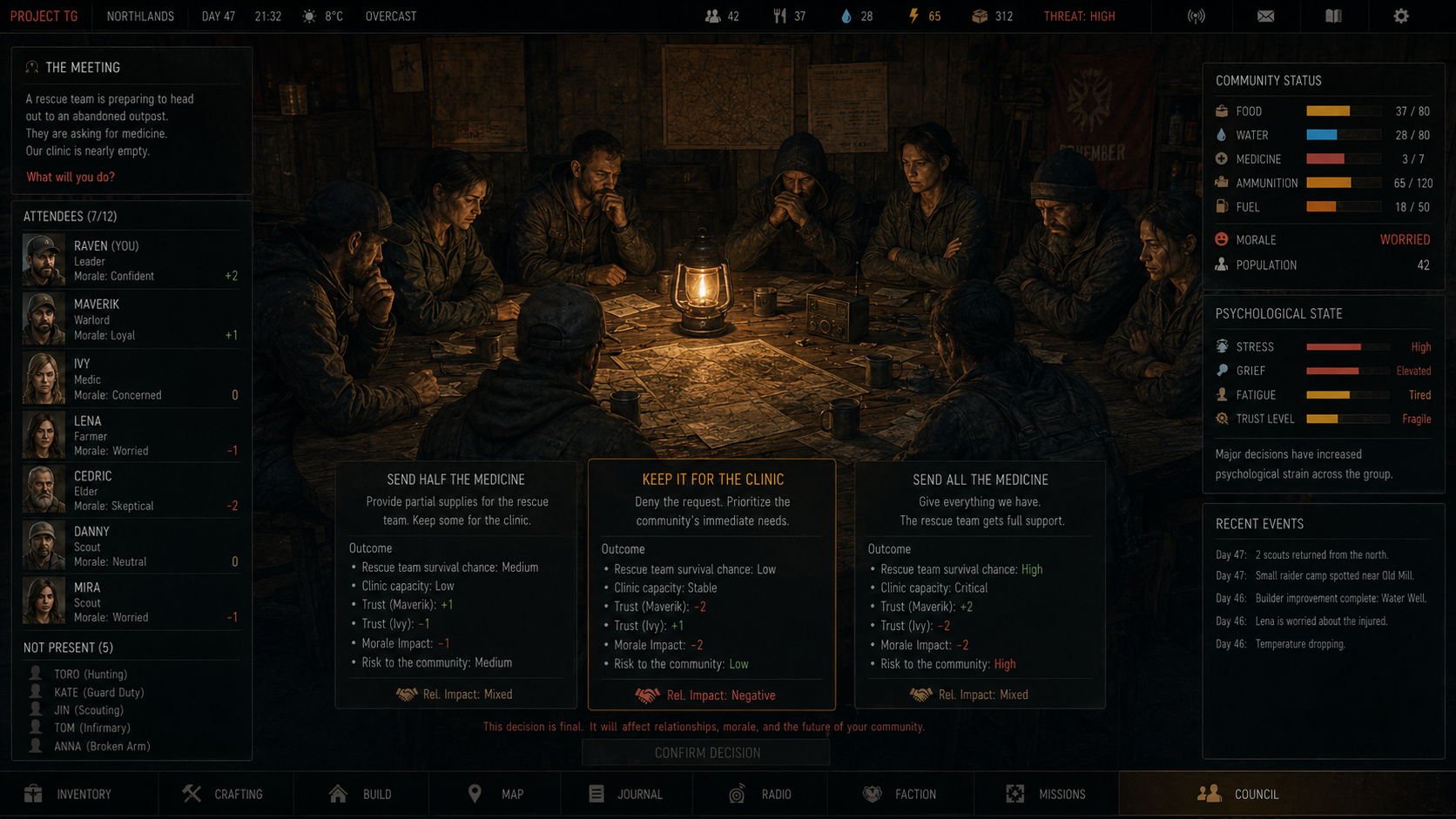
People remember who made a decision, who benefited, who carried the cost, what information was available and who witnessed the result. Pain, grief, fear, attachment, trust, fatigue and prior treatment change how the same decision is received by different people.
- The design target is psychologically grounded. Pain, stress, grief, trust, fear, attachment, fatigue and memory persist as character state and can influence behaviour.
- What happened, who witnessed it, what was reported and what people believe can differ.
- Behaviour, dialogue, refusal, cooperation, withdrawal, risk tolerance and conflict can express psychological state without exposing every internal value as a visible meter.
- Families, friendships, institutions and responsibilities make death and failure consequential beyond lost inventory.
- Psychological systems are planned for specialist review and long-run simulation testing during production.
- Failure changes history. Settlements can split, migrate, collapse, be occupied, rebuilt, or later discovered as ruins.
Human conflict
Human conflict depends on preparation, position, information and logistics
Combat preserves material advantages and strategic differences between communities. A larger and better equipped group may overwhelm a smaller one. A smaller group can survive or win through better terrain, defences, scouting, mobility, training, concealment, supply disruption and leadership.
Human attacks use ordinary world state. A hostile group must reach the location, observe the target, choose a route and position, carry the required equipment and remain undetected long enough to act. Sentries, patrol timing, radios, lighting, cover, elevation, hearing and line of sight determine detection. The server records injuries, deaths, witnesses, evidence, stolen property, damaged infrastructure and later retaliation.
The objective panel in these concept interfaces can display a plan created by player or NPC intent. A predefined quest is unnecessary. Plans can change when the target reroutes, a sentry moves, an alarm is raised, an attacker is seen, or the group withdraws.
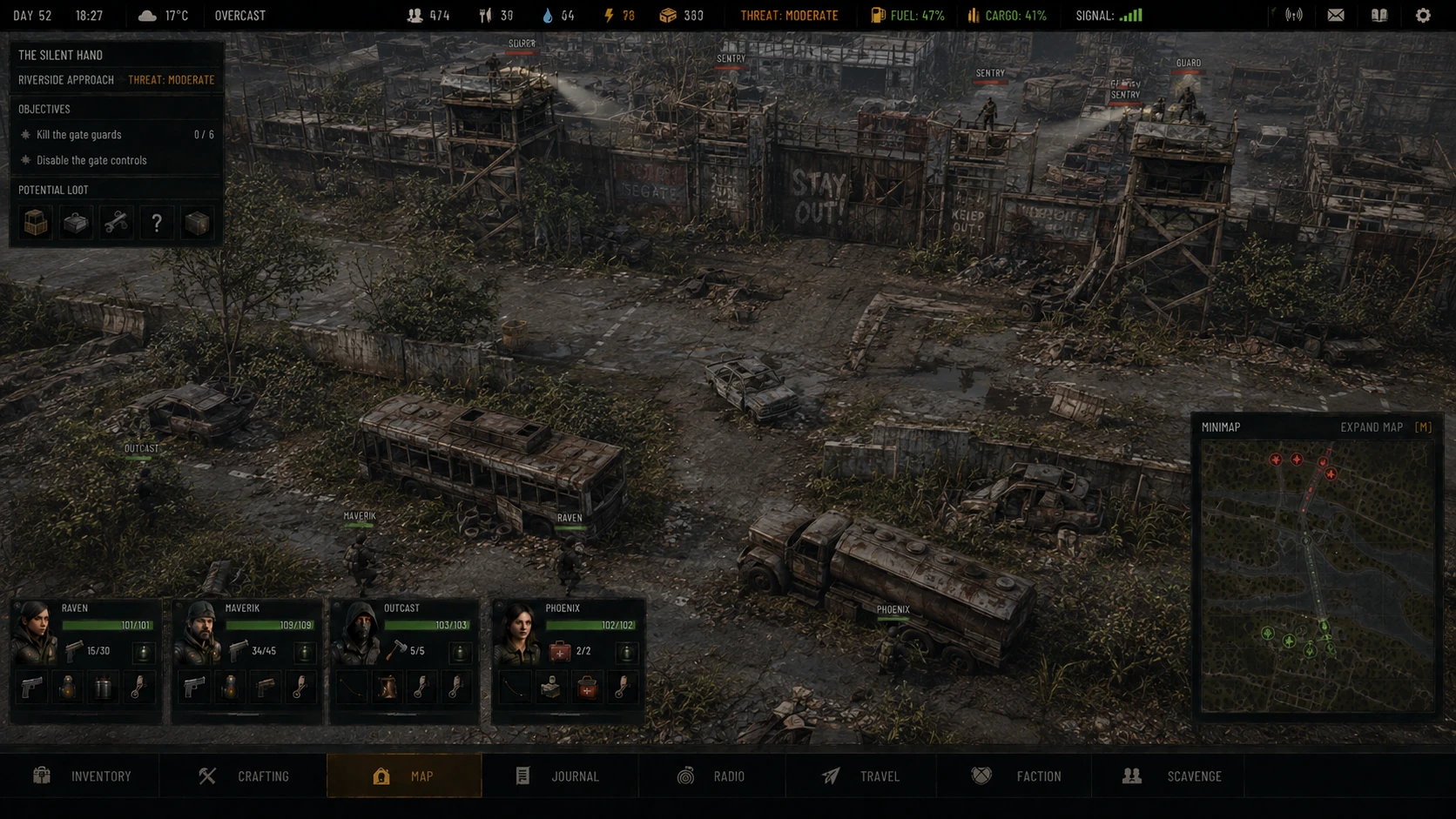
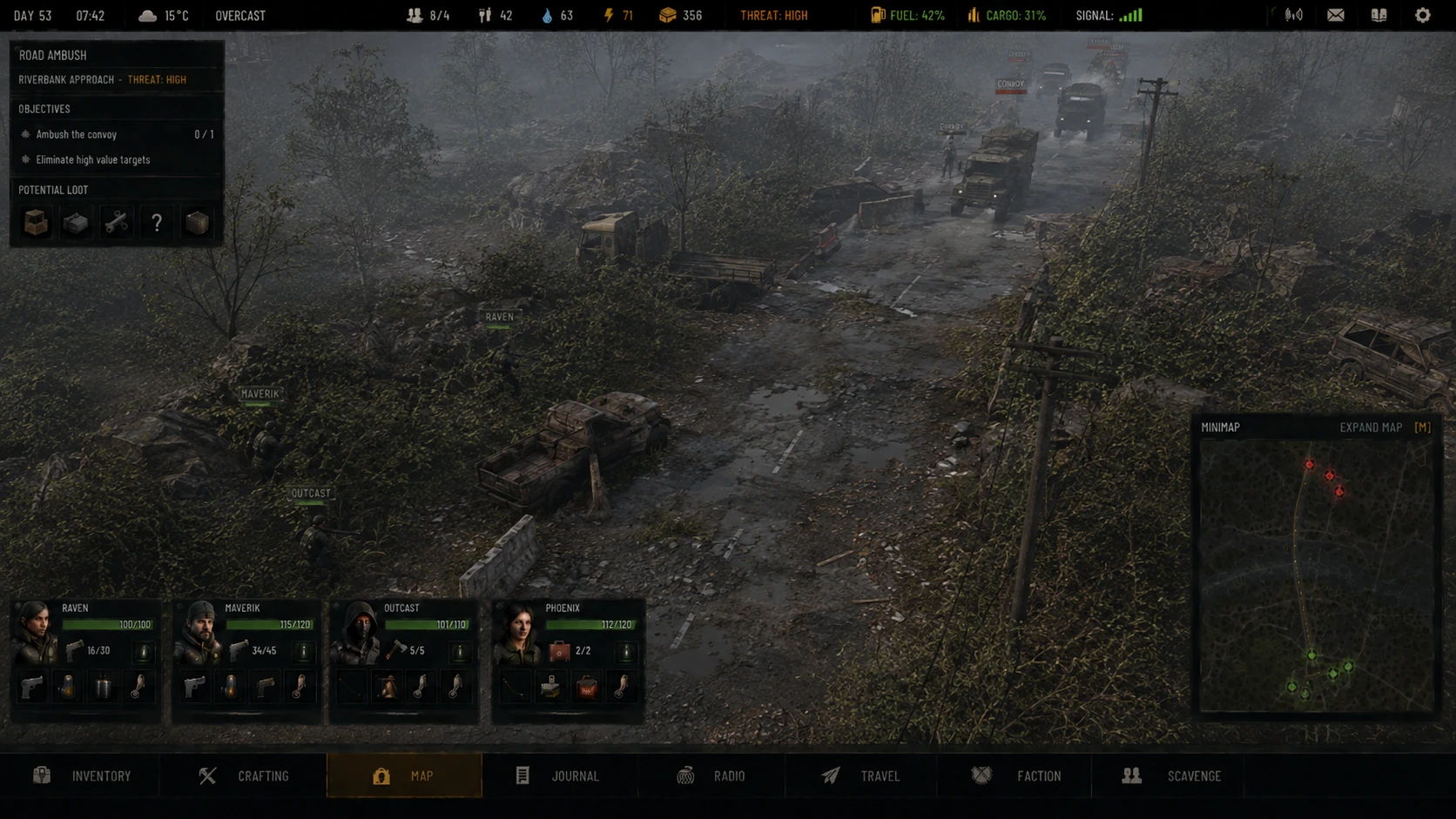

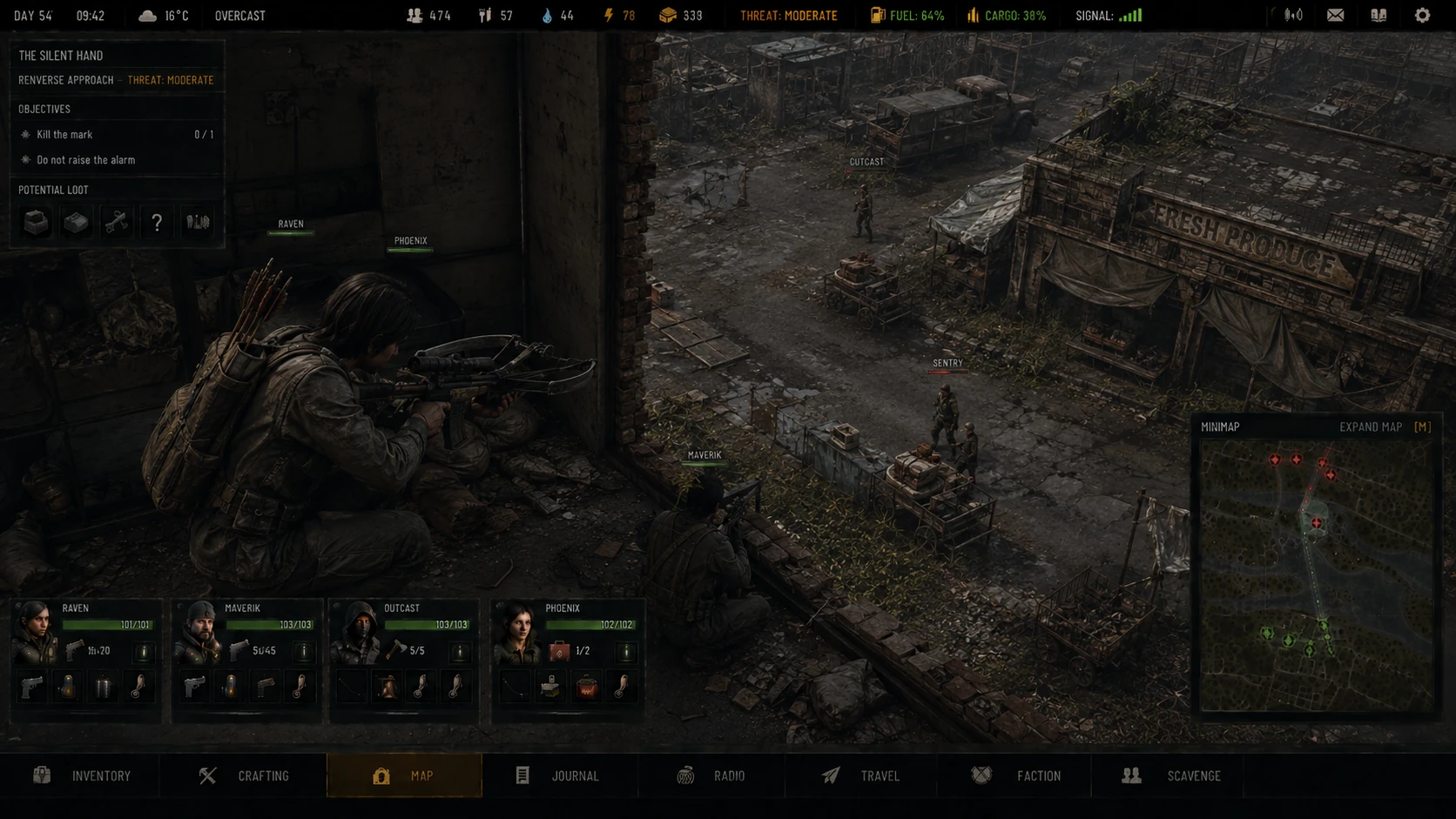
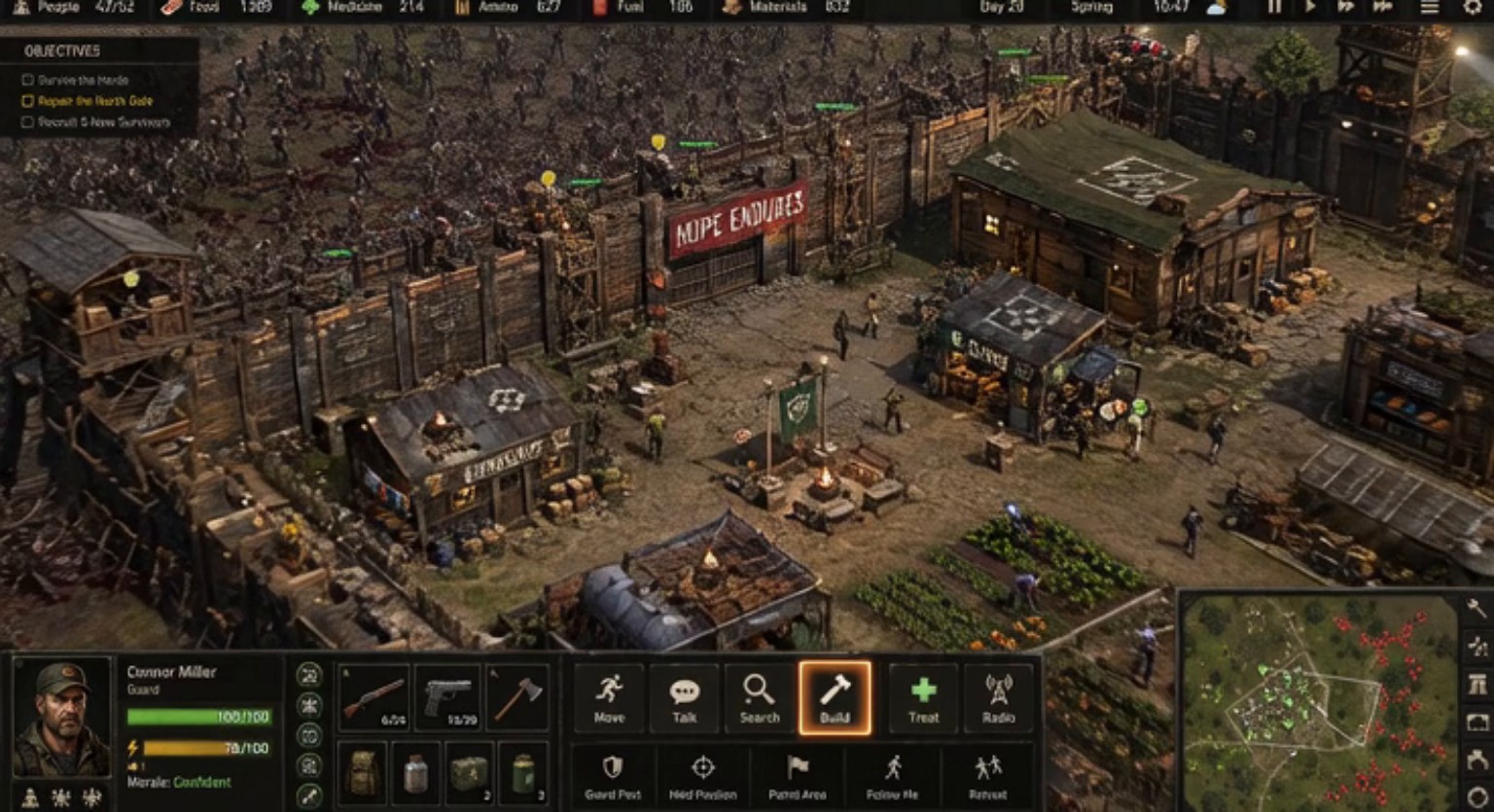
Combat conditions
Walls, gates, watchtowers, roads, blind spots, ammunition, vehicles, medicine, fatigue and supply routes shape the outcome. Battles leave damage, wounded people, missing people, consumed resources and altered settlements.
- Strong defences can multiply the value of fewer people
- Long-distance attacks require food, fuel, transport and communications
- Occupation is harder than destruction
- Military strength has geography and cost
Tactical information
There is no intended omnipresent tactical world chat. Nearby survivors can speak directly. Longer-distance communication depends on radios, devices and infrastructure. Binoculars, scouts, observation posts and working communication networks therefore matter.
- Light affects everyone who can physically see it
- Concealment can prevent a hidden player from being rendered to an opposing client
- Sound can reveal approximate presence without revealing exact identity
- Maps preserve the latest verified information available to the character or community
World modes
Offline and online worlds use the same simulation foundation
Offline single-player provides the complete simulation as a standalone mode. Persistent online worlds continue while players are away. The shortest planned public online world lasts one week. The longest planned public online world lasts five years. Monthly, four-month and yearly profiles provide additional commitment levels.
Fast survival pressure, early shelter, limited infrastructure and rapid consequences.
Enough time for stable camps, local trade, first alliances, shortages and settlement growth.
Supports farming, community institutions, migration, developed conflict and substantial world history.
Long-term diplomacy, infrastructure, ecology, aging, relationships and regional political history gain greater weight.
Multi-year character continuity, aging, settlements, long migrations, institutions and consequences can accumulate across an extended world history.
Persistent world change
Seasons, weather, ecology, disease pressure, horde migration and human decisions alter conditions over time. Curated live world events can introduce major pressures such as storms or migration, while the simulation determines the consequences.
- Updates can add new capabilities, discoveries and pressures
- Routine content updates preserve existing player history
- New systems are designed to attach through data, components and shared rules
Community continuity
An official forum is planned alongside the game from the beginning to support world history, community organisation and longer discussion. Private community areas can follow in-game membership while live tactical intelligence remains inside the game.
- World and community history can survive beyond an individual session
- Faction discussion remains separate from in-world radios, scouting and map intelligence
- Archived worlds can preserve the history players created
Responsibility handover
Persistent worlds should support people with different real-life availability. A player can hand community responsibilities to another trusted person before leaving. Authority, storage access, watch duties and operational roles can move through explicit permissions.
- Logging off does not require surrendering the character to another player
- Responsibilities can be transferred without transferring account ownership
- Returning players re-enter a world that may have changed during their absence
Joining established worlds
New players can enter an established server through plausible survivor circumstances. They may arrive alone, meet an existing community, appear through a refugee or traveller context, or begin in a less populated region that still has room to develop.
- Older servers remain accessible to new players
- Existing settlements create opportunities, risks and political conditions for newcomers
- World history remains intact when a new character enters
Product model
Core progression and survival systems are included in the full game
TG is intended as a complete product at purchase. Core survival, construction, equipment, transport, farming, community capability and progression are included in the game. Microtransactions are limited to cosmetics.
Optional purchases, if used, are cosmetic. Cosmetic purchases carry zero simulation, visibility or progression advantage.
The restrained isometric presentation reserves computational budget for simulation and supports a broad hardware target.
New crops, tools, sensors, buildings, vehicles and other content reuse existing capability systems whenever technically appropriate.
Graphic violence, injury and difficult human decisions serve consequence and realism.
Project status
Project TG is private pre-production work by Peter Far
TG is currently in pre-production as private work by Peter Far. Public material consists of product design, engineering documentation and concept media.
- Owner
- Peter Far
- Status
- Pre-production
- Public material
- Design documentation, engineering specification and concept media
- Representation
- Private project by Peter Far.
Funding and collaboration
Funding and specialist collaboration are open
Relevant discussions include funding, production, engineering, geospatial technology, simulation, online infrastructure, art and specialist research. No funding amount, valuation, equity allocation, revenue forecast, release date or existing partnership is presented on this page.
Funding routes
Appropriate conversations can include private funding, publishing and production support, grant and innovation routes, co-development financing, and strategic technology or data support.
Specialist collaboration
High-value collaboration is relevant where it directly supports the defined world, simulation, tooling, runtime, infrastructure, art, production or research requirements.
Contact
Project TG contact details
The form prepares an email in your own mail application. Form entries remain in your browser until you choose to prepare the email.
